Census's 2024 business data release changed the basis for inventory comparisons
Retrospective report: the September 2026 AIES release paired new estimates with revised 2023 data and a different bridge to older wholesale and retail surveys.
- Event / announcement date
- 2026-09-03
- Earliest linked source date
- 2026-09-03
- NewsTumble first published
- 2026-10-26T06:04:58Z
- NewsTumble updated
- 2026-10-26T06:04:58Z
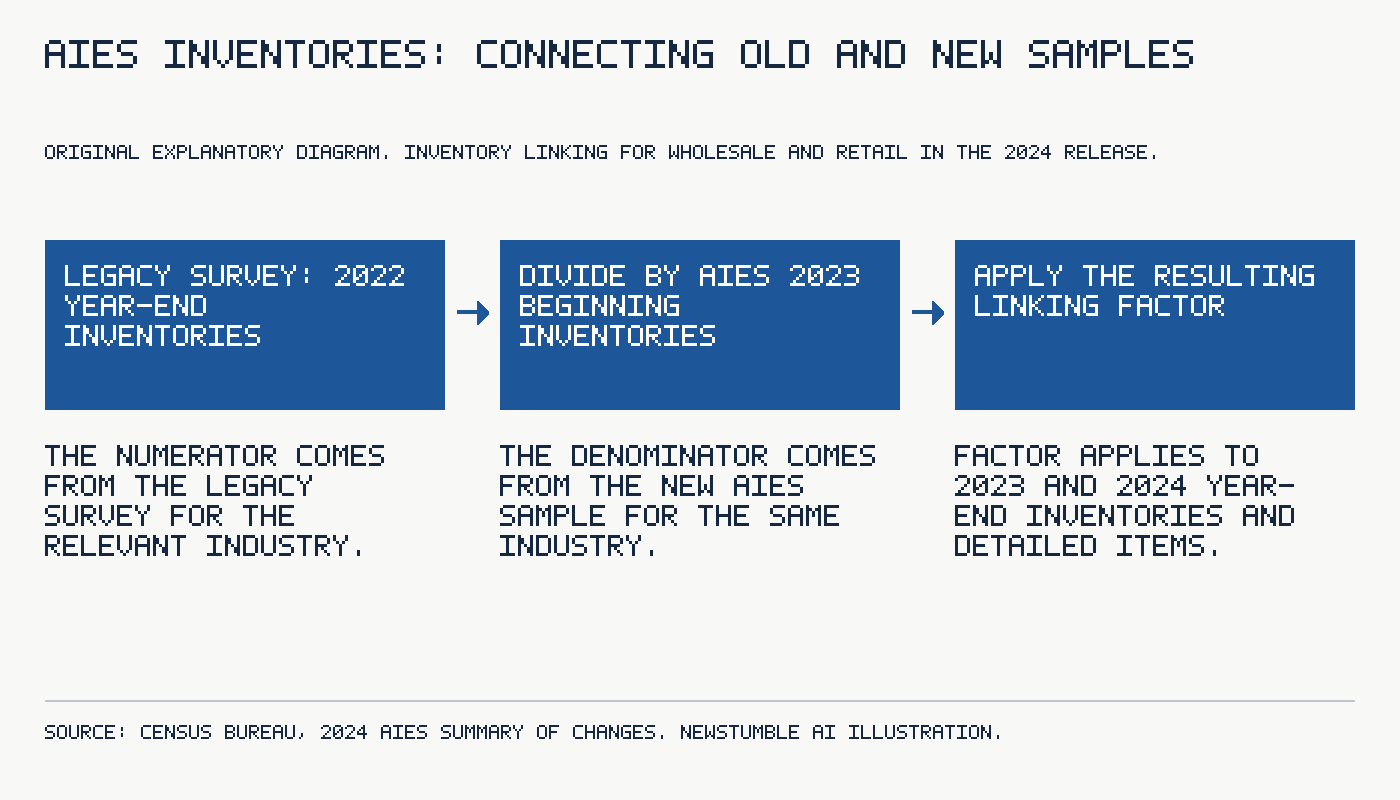
The Census Bureau released the full 2024 Annual Integrated Economic Survey dataset on September 3, 2026, giving users new estimates of business revenue, expenses, payroll and employment. But anyone comparing wholesale or retail inventories across years also needed to read the accompanying changes: the agency revised earlier figures and changed how the new survey connects to its predecessors. The release date was in 2026; the activity being measured was in 2024. [1] [2]
AIES replaced and combined seven annual business surveys. Its umbrella brings recurring measures of business activity into one survey, but that administrative consolidation does not make every historical number directly comparable. The 2024 changes document says 2023 estimates were revised using more accurate information received later. A comparison drawn from an older downloaded 2023 table could therefore use a superseded starting point. [2] [3]
The inventory adjustment was more specific than a routine correction. Previously, wholesale and retail inventory estimates had been linked to the old surveys using revenue estimates. The updated calculation instead divides the legacy survey's 2022 year-end inventory estimate by the new AIES sample's 2023 beginning inventory estimate for the same industry. The resulting factor applies to 2023 and 2024 year-end inventories and specified detailed inventory measures. It changes the statistical bridge between samples, rather than describing a new shipment or sale. [2]
The broader estimates also need their survey context. The release describes approximately 385,000 sampled businesses and a universe of domestic, private, nonfarm employers in the 50 states and District of Columbia. The methodology explains that total estimates combine weighted reported and imputed information. Missing responses can be filled through methods including regression and substitution; the published totals are consequently not a simple addition of answers received from every business. [1] [4]
This distinction matters for the precision of comparisons. Census recommends incorporating sampling-error information into analysis. Its methodology also explains that standard errors and coefficients of variation describe sampling variability, not every systematic bias. A small apparent difference between industries or years therefore needs the relevant uncertainty measures before it can support a confident claim about change. [4]
There are usable routes into the data. The tables reference allows users to change geographies and industry codes, inspect notes and download spreadsheet or CSV files. Complete tables are also available through the download directory and an API. Geographic detail needs checking table by table: the September release supplied national, regional and divisional estimates, while state estimates were available only for selected sectors. [1] [5]
The practical reading sequence is to select the relevant industry and geography, use the revised comparison figures, and carry the method notes alongside the numbers. The estimates are not adjusted for price changes, so changes in dollar amounts should not automatically be described as changes in physical output. These documents improve the basis for interpreting the release; they do not establish the fortunes of an individual business or a causal explanation for every change. [1] [2] [4]
The source
- U.S. Census Bureau: Census Bureau Releases New Annual Integrated Economic Survey Data ↗
Source published 2026-09-03 · reviewed October 25, 2026 · Actual displayed source publication date; event and retrieval dates remain separate. - U.S. Census Bureau: 2024 Annual Integrated Economic Survey (AIES) Summary of Changes ↗
Undated reference · reviewed October 25, 2026 · No publication date is given within this inspected PDF; 2024 is the survey reference year, not a publication date. Associated release is September 3, 2026 but is not imputed to this document. - U.S. Census Bureau: Annual Integrated Economic Survey (AIES) ↗
Undated reference · reviewed October 25, 2026 · No publication date is given for this context reference. Any revision marker, historical call opening date or date in a news listing is not treated as its publication date. - U.S. Census Bureau: 2024 Annual Integrated Economic Survey (AIES) Methodology ↗
Undated reference · reviewed October 25, 2026 · No publication date is given within this inspected PDF; 2024 is the survey reference year, not a publication date. Associated release is September 3, 2026 but is not imputed to this document. - U.S. Census Bureau: 2024 AIES Data ↗
Source published 2026-09-03 · reviewed October 25, 2026 · September 3, 2026 is displayed above Summary of Changes; this reference is mutable and includes later additions. Only the cited access instructions are used.
About this item: Retrospective report. No first-hand reporting or independent testing is claimed. Corrections policy.