Census's new nonemployer data count businesses, not the people working independently
Retrospective report: the September 2026 release opens a detailed view of 2024 businesses without payroll. Its definitions put limits on gig-work and local-economy claims.
- Event / announcement date
- 2026-09-29
- Earliest linked source date
- 2026-09-29
- NewsTumble first published
- 2026-10-26T06:04:58Z
- NewsTumble updated
- 2026-10-26T06:04:58Z
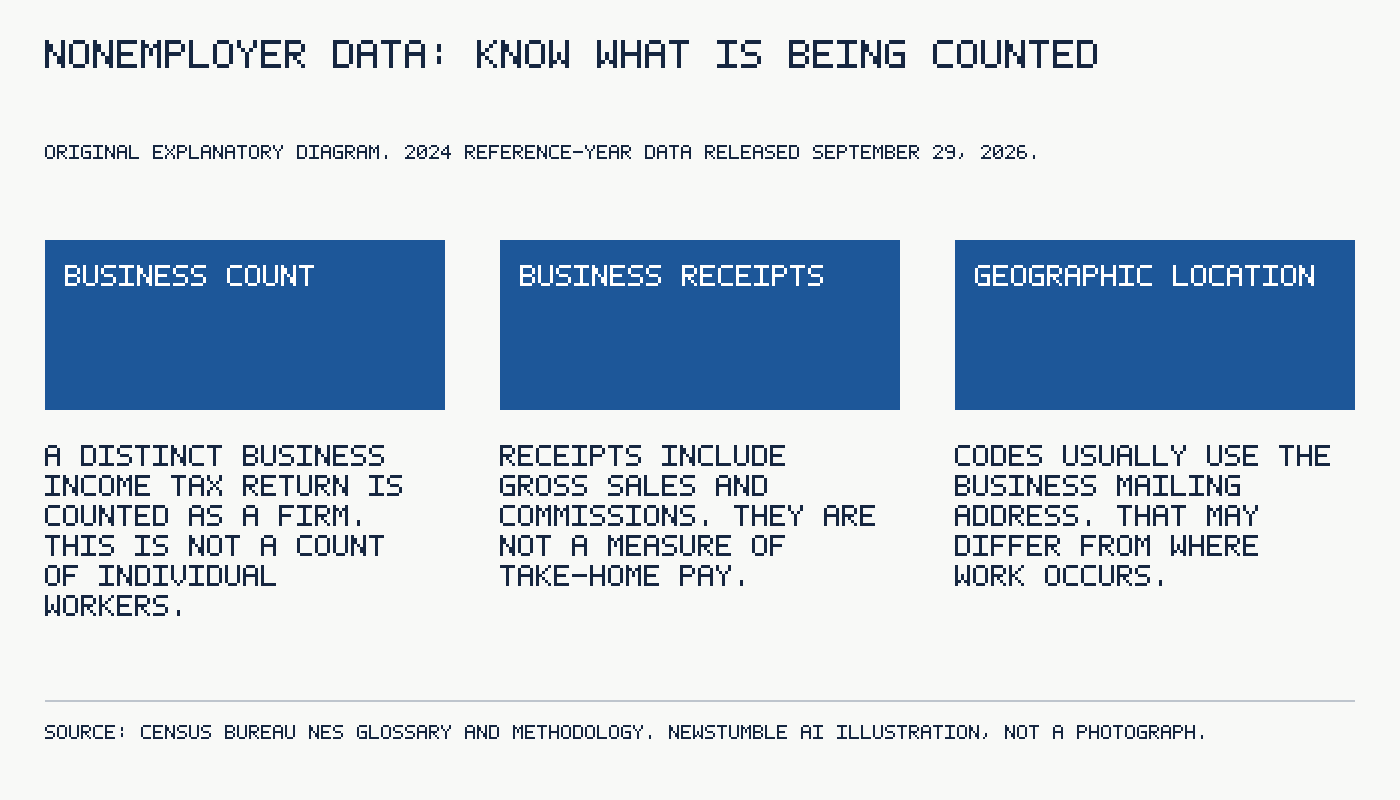
The Census Bureau released its 2024 Nonemployer Statistics on September 29, 2026, providing industry and geographic detail on businesses with no paid employees. It is a useful source for examining economic activity that employer statistics leave out. But the unit being counted is a business tax return, not an individual worker, and the receipts measure should not be mistaken for an owner's take-home income. [1] [2]
The release covers tax-subject businesses meeting a receipts threshold: at least $1,000 annually, or $1 in construction. It supplies establishment counts and total receipts across 18 industry sectors using the 2022 industry classification. County and metropolitan detail are available, while legal-form breakdowns are limited to national and state figures and receipts-size classes to the national level. These are 2024 business statistics released in 2026, not a contemporaneous employment survey. [1]
The distinction begins in the source records. Census builds the nonemployer universe primarily from IRS business-income-tax information rather than conducting a survey to identify these businesses. Its methodology describes screening records to remove employers incorrectly included in that universe. The tabulations have no sampling error because they are not sample-based, but coding mistakes, coverage gaps and misclassification can still affect the results. In particular, Census says it cannot reliably identify every company that leases all its employees. [3]
The glossary explains another limit on interpreting the totals as a gig-worker count. NES treats each distinct business income tax return as a firm and uses firm, business and establishment interchangeably. Receipts include gross sales, commissions and business income reported on tax returns. Those definitions describe business records and flows of money; they do not isolate earnings after business costs or identify how many people depend on that work. [2]
Location requires similar care. Census says most geographic codes come from a business mailing address, which may differ from the place where operations occur. A county table can consequently describe the recorded business geography without locating every job or customer transaction. The program's overview identifies state and local planning and analysis of independent-worker industries among its uses, but those uses do not remove this limitation. [3] [4]
Historical comparisons need more than a line drawn through annual totals. Census warns that it does not restate older estimates for changes in industry definitions, geography or methods, and does not recommend treating multiple years as a time series. It updated receipts cutoffs in reference year 2022. Readers comparing an industry with earlier years therefore need to establish whether the relevant definitions and inclusion rules match. [3]
The new release points users to tables on data.census.gov, downloadable datasets and an API. When examining small areas or industries, the published flags belong with the figures: the glossary marks withheld or noncomparable values and identifies the degree of confidentiality noise applied to cells. Public access makes the records usable for scrutiny; it does not turn every apparent change into a verified change in workers' livelihoods. [1] [2]
The source
- U.S. Census Bureau: Census Bureau Releases 2024 Nonemployer Statistics ↗
Source published 2026-09-29 · reviewed October 25, 2026 · September 29, 2026 is displayed within CB26-TPS.59; the reference year is 2024. The page says tip sheet only, despite its press-releases URL. - U.S. Census Bureau: Nonemployer Statistics (NES) Glossary ↗
Undated reference · reviewed October 25, 2026 · No publication date is given for this context reference. Page Last Revised markers are not treated as publication dates. - U.S. Census Bureau: Nonemployer Statistics Methodology ↗
Undated reference · reviewed October 25, 2026 · No publication date is given for this context reference. Page Last Revised markers are not treated as publication dates. - U.S. Census Bureau: About the Nonemployer Statistics Program ↗
Undated reference · reviewed October 25, 2026 · No publication date is given for this context reference. Page Last Revised markers are not treated as publication dates.
About this item: Retrospective report. No first-hand reporting or independent testing is claimed. Corrections policy.