NIST’s July documentation draft put the audience inside AI transparency work
The proposed templates concern public records about models and datasets, with important limits on scope and status.
- Event / announcement date
- 2026-07-29
- Earliest linked source date
- 2026-07-29
- NewsTumble first published
- 2026-10-26T07:43:12Z
- NewsTumble updated
- 2026-10-26T07:43:12Z
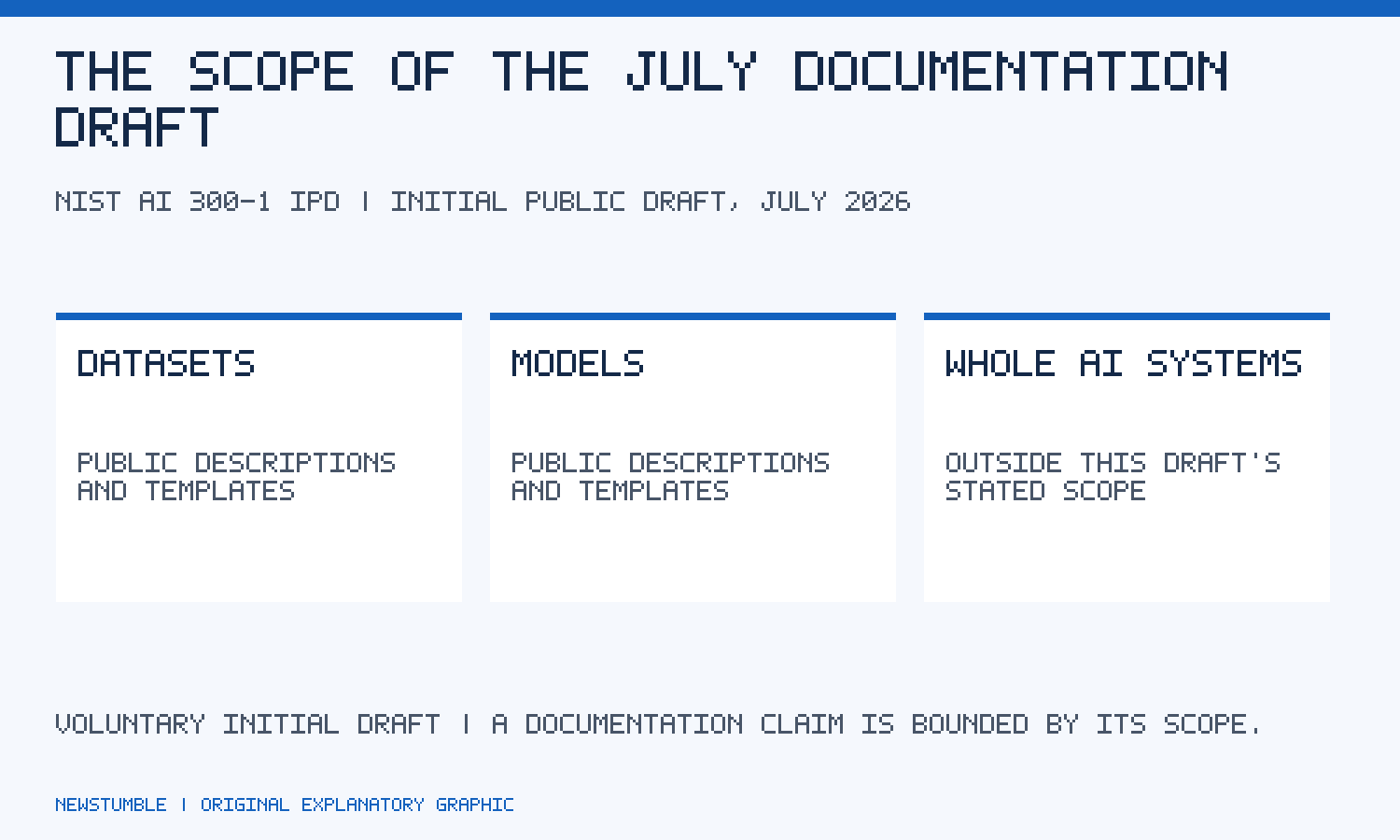
NIST released an initial public draft on public-facing AI documentation on July 29, 2026; its bibliographic entry is dated July 30. The document proposed guidance and templates for describing datasets and models. For people trying to assess an AI product, the practical question is what a public description enables them to understand—and which parts of the product it leaves outside its scope. [1] [2] [3]
The draft applies even when the underlying model or dataset is not publicly available. It excludes documentation of entire AI systems, which can combine many components, because NIST assessed those documentation practices as less mature. A document conforming to this proposal would therefore not, by that fact alone, describe every component of a deployed service. [4]
The proposal says public descriptions should be accurate, understandable and current, with detail matched to their audience. It identifies contact points or redress mechanisms as information some audiences may need. It also recommends omitting private, proprietary or impermissible material. These provisions frame transparency as usable information with boundaries, rather than an instruction to publish everything. [4]
This was a voluntary draft, not a federal disclosure rule. Its foreword distinguishes conformity language from regulatory intent. NIST said it would consider feedback received by September 16, 2026; that date has passed. The source describes a proposed route through standards committees, without establishing that a final international standard has been adopted. [4]
The institutional problem behind the project predates this draft. NIST’s project description says stakeholders wanted faster standardization while preserving rigor, and broader expertise from people who develop, use, research or are affected by AI. Its chosen documentation topic covers fields that should or could appear in public artifacts. That gives affected people a place in the stated design of the process, without proving how representative participation actually became. [3]
The process also leaves consequential decisions ahead. NIST first solicits views on topics and scope, releases a concept paper, revises drafts after further input and then proposes formal standardization. The agency says its Zero Drafts remain NIST proposals and may change in a standards organization. Readers assessing a documentation claim therefore need to identify the version and scope being claimed, alongside the information actually provided. [3]
The source
- NIST: Super Intelligence Standards ↗
Undated reference · reviewed October 25, 2026 · No publication date is given on this reference; retrieval and page-update dates are not treated as publication dates. - NIST: Guidance and Templates for Public-Facing AI Documentation: An AI Standards Zero Draft (Initial Public Draft) ↗
Source published 2026-07-30 · reviewed October 25, 2026 - NIST: NIST’s AI Standards Zero Drafts Pilot Project ↗
Undated reference · reviewed October 25, 2026 · No publication date is given on this reference; retrieval and page-update dates are not treated as publication dates. - NIST: Guidance and Templates for Public-Facing AI Documentation: An AI Standards Zero Draft ↗
Source published 2026-07-29 · reviewed October 25, 2026 · Release day expressly stated by the official NIST standards page; PDF imprint says July 2026.
About this item: Retrospective report. No first-hand reporting or independent testing is claimed. Corrections policy.