An AI standard needs an impact test, a January NIST report argued
A conceptual evaluation proposal asks what would have happened without a standard, and whose outcomes count.
- Event / announcement date
- 2026-01-15
- Earliest linked source date
- 2026-01-15
- NewsTumble first published
- 2026-10-26T07:43:12Z
- NewsTumble updated
- 2026-10-26T07:43:12Z
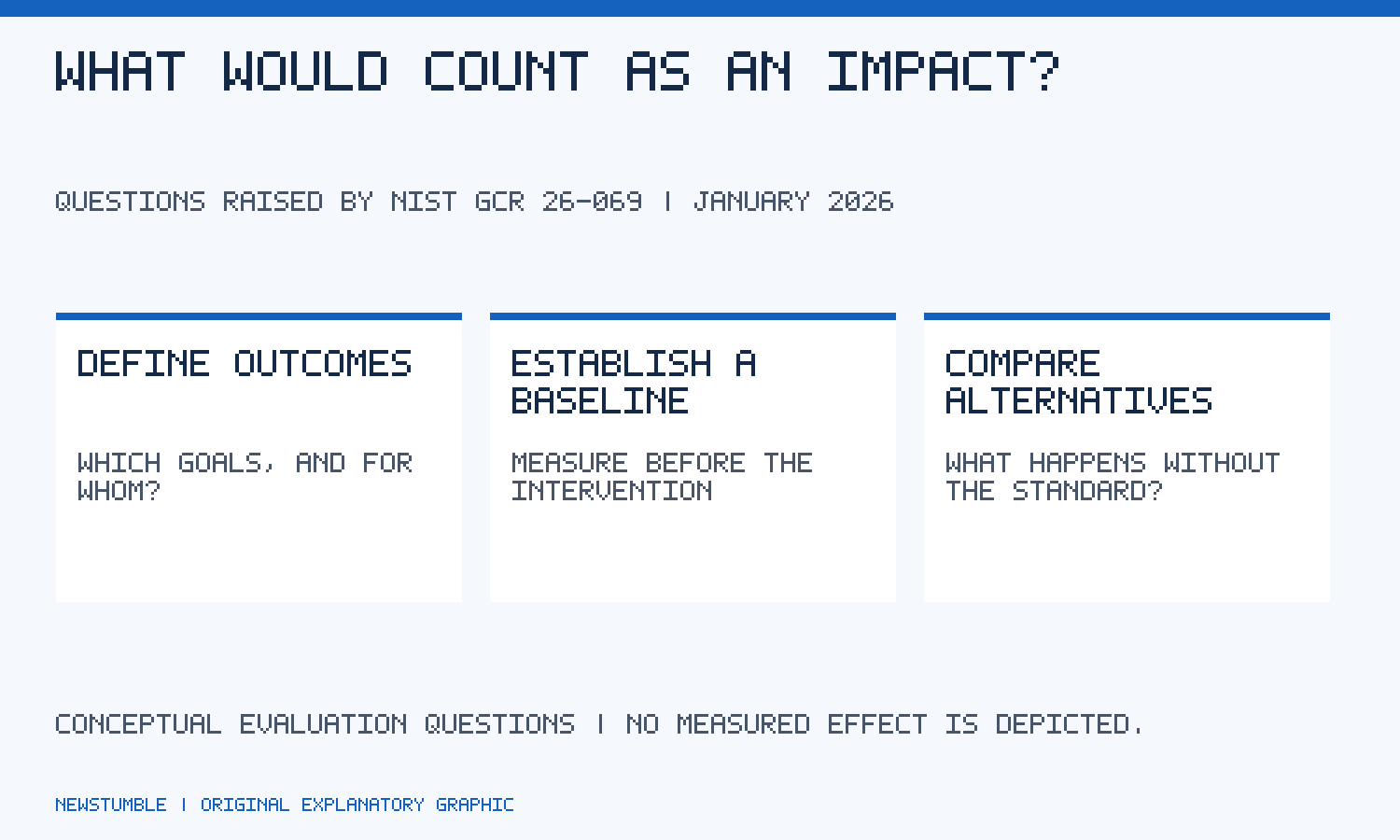
NIST released a report on January 15, 2026, asking how anyone should judge whether developing an AI standard achieves its intended goals. The agency described a gap: there was no formal or shared method for measuring standards development against innovation and public trust. Publication itself was therefore a starting point for evaluation, rather than evidence of success. [1]
The report, by NIST associate and New York University professor emerita Julia Lane, offers a conceptual approach, rather than a completed impact study. Its agreement disclaimer says the contents do not necessarily reflect NIST or U.S. government policy. The proposal should be read as an argument for developing evidence, with that institutional qualification intact. [2]
Its central question is what would have happened without the standard. A comparison with an earlier year alone can mistake wider changes for the effect of standardization. Lane also warns that voluntary adopters may differ systematically from nonadopters, making a simple comparison between those groups misleading. [2]
That changes the work required before an evaluation begins. The report calls for identifying stakeholders early, deciding what outcomes matter and considering comparison groups and baseline measures. It recommends a feasibility study before choosing an evaluation design. These are proposed safeguards for learning whether standards work, without claiming that their effects have already been measured. [2]
NIST’s broader standards work supplies the context for that question. Its standards page connects common technical standards with data, performance and governance, and describes coordination across government and industry. It also records a global-engagement plan released in July 2024 after public comments. The January report addressed how to evaluate such efforts, rather than announcing a new model-performance benchmark. [1]
The agency’s separate Zero Drafts project illustrates the distance between preparing a document and completing standardization. NIST collects stakeholder input, develops proposals and submits them into a private-sector-led consensus process. Its project description explicitly says proposals can still change during formal standardization. That process creates several stages at which an evaluator would need to specify what was actually delivered and what remains a goal. [3]
The source
- NIST: Super Intelligence Standards ↗
Undated reference · reviewed October 25, 2026 · No publication date is given on this reference; retrieval and page-update dates are not treated as publication dates. - NIST: A Possible Approach for Evaluating AI Standards Development ↗
Source published 2026-01-15 · reviewed October 25, 2026 · January 15 is the documented release date, not a day inferred from the report month. - NIST: NIST’s AI Standards Zero Drafts Pilot Project ↗
Undated reference · reviewed October 25, 2026 · No publication date is given on this reference; retrieval and page-update dates are not treated as publication dates.
About this item: Retrospective report. No first-hand reporting or independent testing is claimed. Corrections policy.