Census rewrote its business-formation series before readers compared January figures
The February 2026 update changed industry coding and the definition of applications considered likely to become employers.
- Event / announcement date
- 2026-02-11
- Earliest linked source date
- 2026-02-11
- NewsTumble first published
- 2026-10-26T07:43:12Z
- NewsTumble updated
- 2026-10-26T07:43:12Z
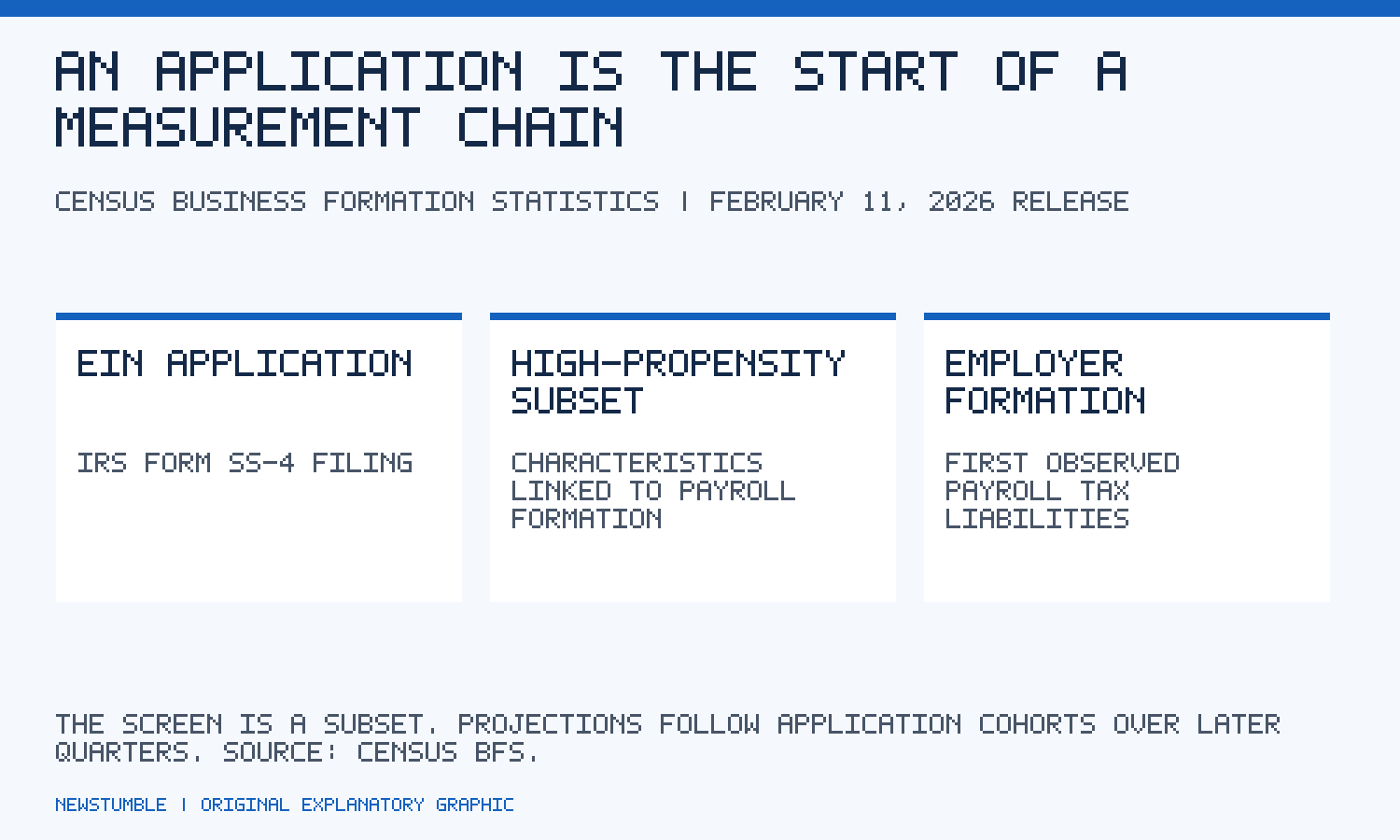
The Census Bureau’s February 11, 2026 Business Formation Statistics release did more than report January applications. It applied an annual update that restated the full time series to 2022 industry codes and changed which applications counted as high-propensity or corporation applications. Anyone comparing a saved older release with the new figures needs to account for the changed statistical basis. [1]
The definition change removed applications associated with internet sales from the high-propensity and corporation series, across the entire history. Census’s methodology explains the reason: after noticing a spike in corporate internet-sales applications, it checked whether those applicants became employers. Historically, they had low transition rates and few instances of quarterly payroll in its Business Register. [1] [2]
That is a change in a statistical screen, rather than a finding that online selling stopped being a business activity. The high-propensity series is designed around characteristics on IRS Form SS-4 associated with becoming a business with payroll. Applications for an employer identification number, the first observation of payroll liabilities and a projection of future employer formation are different stages. [2]
The January release illustrates the distinction. It reported 532,319 seasonally adjusted applications, including 147,516 high-propensity applications, and projected that 29,863 employer businesses would form from that month’s applications within four quarters. The last figure is a forecast about a cohort over time, not a count of businesses that opened during January. [1]
The update also refreshed formation information and seasonal factors. Census normally revises the prior five years of industry codes when administrative information improves, but differences between the 2017 and 2022 classifications prompted a full-series restatement. Older downloaded estimates therefore may have a different classification and adjustment basis. [1]
For researchers and community economic-development organizations, the useful comparison is a consistent series with the same definitions and data vintage. A larger application count alone does not establish more operating employers or jobs. The source supplies the mechanism behind that caution: employer formation requires payroll evidence, while the newest cohort’s formation figures are forward-looking projections. [2]
The source
- U.S. Census Bureau: Business Formation Statistics, January 2026 ↗
Source published 2026-02-11 · reviewed October 25, 2026 - U.S. Census Bureau: Business Formation Statistics: Methodology ↗
Undated reference · reviewed October 25, 2026 · No publication date is given on this reference; retrieval and page-update dates are not treated as publication dates.
About this item: Retrospective report. No first-hand reporting or independent testing is claimed. Corrections policy.