Copyright Office bulk-data update widened research access, with a search warning attached
The January 2026 release extends digital records through June 2025 and offers several structures for analysis.
- Event / announcement date
- 2026-01-22
- Earliest linked source date
- 2026-01-22
- NewsTumble first published
- 2026-10-26T07:43:12Z
- NewsTumble updated
- 2026-10-26T07:43:12Z
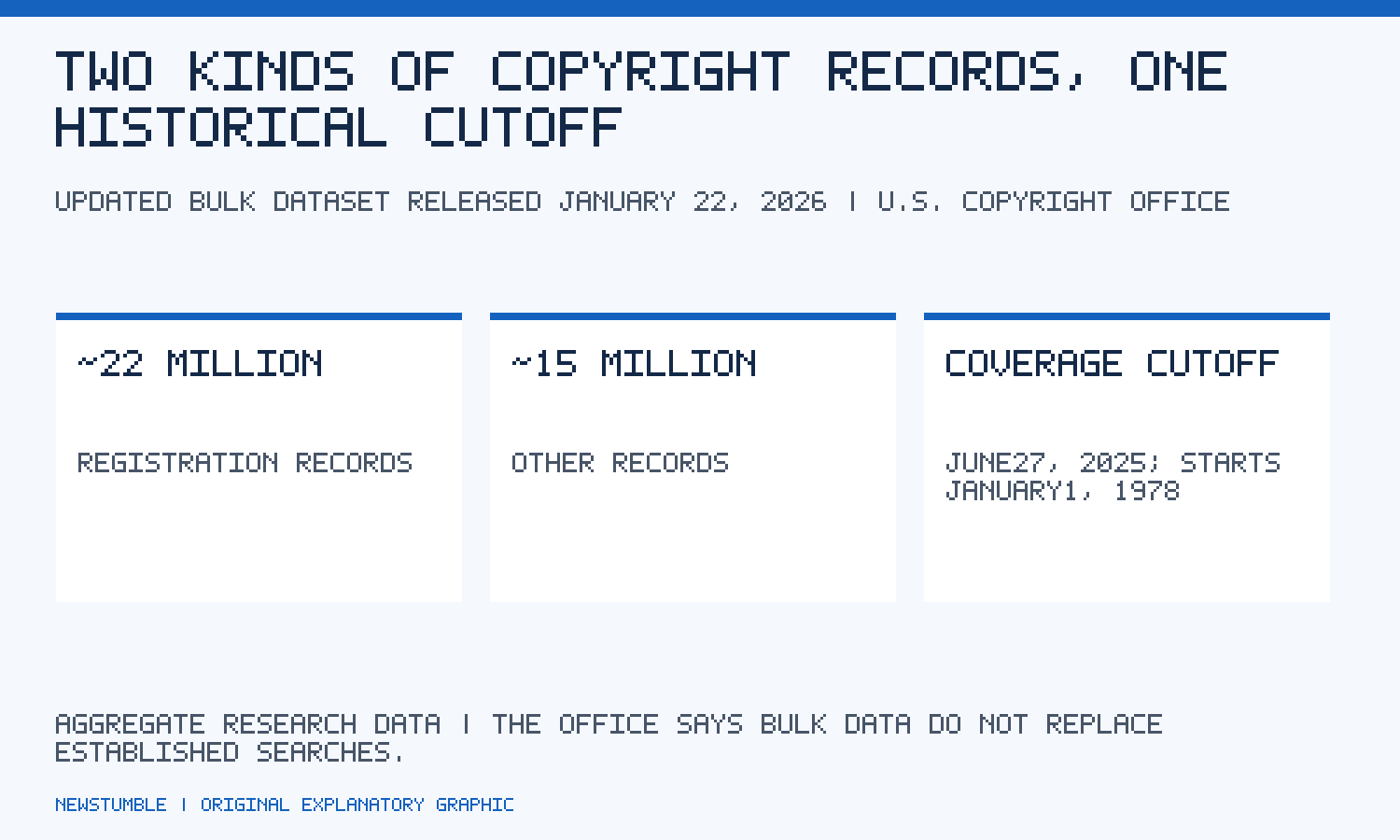
The U.S. Copyright Office released an updated registration and recordations bulk dataset on January 22, 2026, its first major update since the 2022 release. The new version contains roughly 22 million registration records covering January 1, 1978, through June 27, 2025. That cutoff matters: this is a later release of historical records, not a live inventory of everything created or registered in 2026. [1]
The original release contained about 20 million registration records through July 8, 2021. The updated files come in raw unparsed MARC, parsed CSV and tabular CSV formats, with long and wide structures available. This gives researchers ways to examine many records systematically instead of repeatedly searching for individual entries; it does not mean the underlying works have been licensed for reuse. [1]
The dataset reference also includes approximately 15 million other records and describes information on authors, work types and publication status. It separates registration files from renewals, cancellations, preregistrations and recordations. Work-type downloads include serials, photographs, motion pictures, sound recordings and literary works. Those distinctions give media researchers a more specific unit of analysis than treating every row as a newly created work. [2]
The access change has a documented research history. The Office says the earlier dataset supported its reports on copyright registrations’ geography and creative industries’ pandemic recovery. Its economic-research program also emphasizes helping outside researchers understand the institutional factors behind registration data. Those are examples of use and research support, rather than proof that the updated files already produced a new finding. [1] [3]
The download page carries an important boundary: the bulk data do not replace or supersede the public catalog or existing Copyright Office search practices and should not be relied on for legal matters. It directs users to separate guidance for investigating a work’s status and for personal information in public records. A dataset useful for aggregate research therefore is not, by itself, a clearance decision for a newsroom or publisher. [2]
For a study of media production, the practical starting point is to name the record type, covered period and fields being analyzed, then consult the linked field documentation. The Office’s landing page provides an overview and keeps the October 2022 version in an archive. That makes the chosen version visible, while leaving researchers responsible for explaining what registration and recordation activity can—and cannot—show about creative work. [2] [3]
The source
- U.S. Copyright Office: Copyright Office Releases Updated Version of Copyright Registration and Recordations Bulk Dataset ↗
Source published 2026-01-22 · reviewed October 25, 2026 - U.S. Copyright Office: Copyright registration and recordation datasets ↗
Undated reference · reviewed October 25, 2026 · No publication date is given on this reference; retrieval and page-update dates are not treated as publication dates. - U.S. Copyright Office: Economic Research ↗
Undated reference · reviewed October 25, 2026 · No publication date is given on this reference; retrieval and page-update dates are not treated as publication dates.
About this item: Retrospective report. No first-hand reporting or independent testing is claimed. Corrections policy.