Reuters Institute found creator news mostly supplemented established media
The 2026 report separates weekly reach from reliance, while its online sampling limits comparisons.
- Event / announcement date
- 2026-06-16
- Earliest linked source date
- 2026-06-16
- NewsTumble first published
- 2026-10-26T07:43:12Z
- NewsTumble updated
- 2026-10-26T07:43:12Z
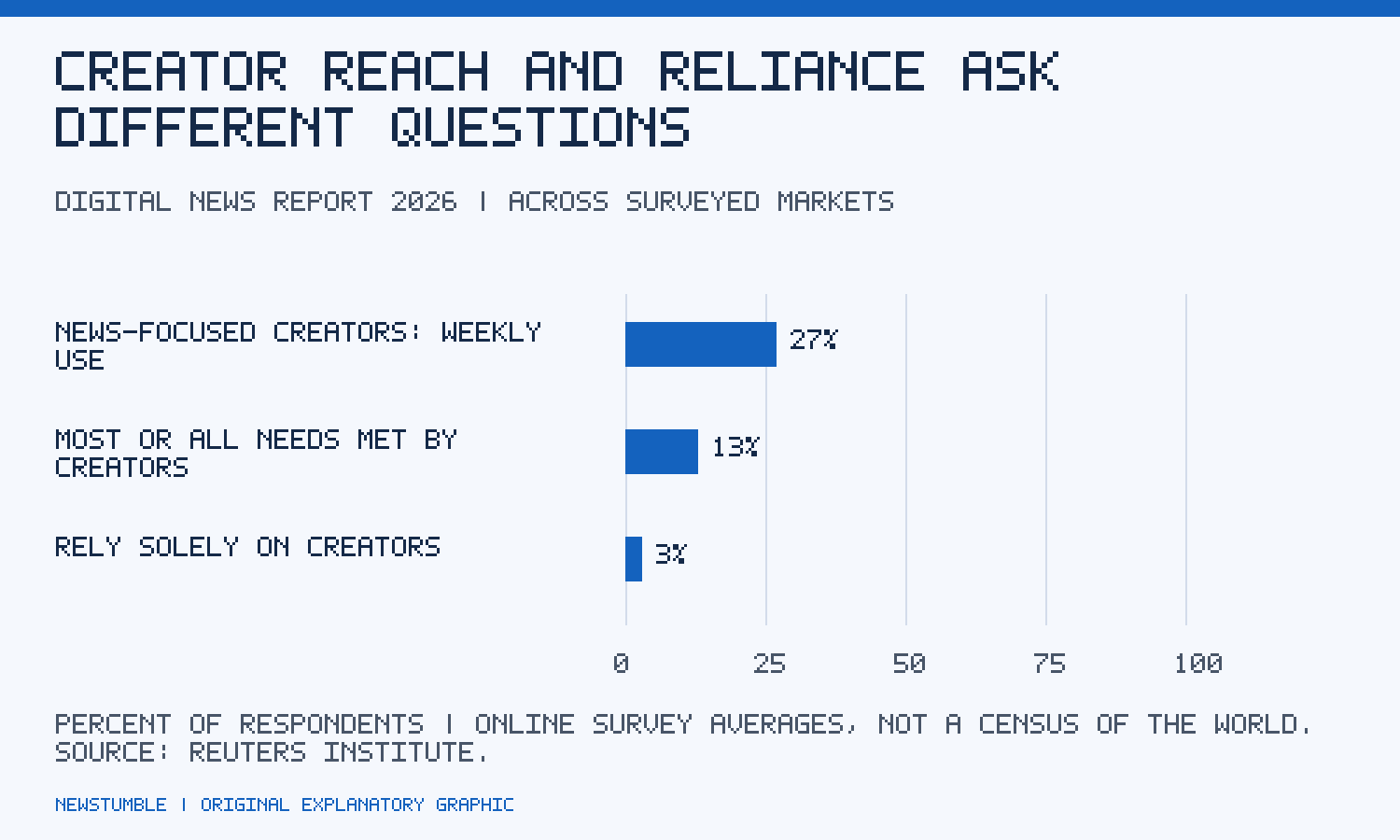
The Reuters Institute’s Digital News Report, released June 16, 2026, found that 27% of respondents across its surveyed markets got news weekly from news-focused creators. Yet its executive summary reported that 13% had most or all of their news needs met by those creators and 3% relied solely on them. Reach and dependence were different measures, leaving a more complicated picture than a wholesale replacement of news organizations. [1] [2]
The report’s creator chapter describes a supplementary role: interpreting, explaining or reacting to news, rather than primarily breaking or investigating stories. It also describes hybrid journalist-creators who work within established organizations while using personal presentation and social formats. Its four creator ecosystems are explicitly overlapping analytical categories, not fixed boxes that every country fits. [1]
That distinction matters for anyone evaluating a news item encountered through a personality. The person presenting it, the organization employing that person and the original reporting can occupy different roles in the information chain. The chapter’s hybrid examples show why a creator’s presence on a platform does not by itself establish independence from a newsroom or the replacement of its reporting. [1]
The findings are survey responses, not a tracking study of consumption or an independent test of reliability. YouGov conducted the principal online fieldwork from mid-January through February 2026, using quotas and weighting. The methods note that recalled behavior may differ from actual behavior and that perceptions describe opinion. An audience finding about trust therefore cannot certify the accuracy of a creator’s individual claim. [3]
Online coverage also affects whose habits are visible. The methods say India, Kenya, Nigeria and South Africa represent younger English-speaking populations rather than their national populations; Kenya and Nigeria were restricted to ages 18–50. Older and less-affluent people tend to be underrepresented more generally. The reported cross-market averages should therefore not be read as a population-weighted count of everyone in the world. [3]
The report also says conventional margins of error cannot be computed from this nonprobability approach and urges strong caution over differences of two percentage points or less. For newsrooms, the evidence supports asking which audience needs creators supplement and how reporting reaches those audiences. It does not establish that creator use caused a decline in trust or a loss of newsroom revenue. [2] [3]
The source
- Reuters Institute for the Study of Journalism, University of Oxford: How news creators are impacting politics and media around the world ↗
Source published 2026-06-16 · reviewed October 25, 2026 - Reuters Institute for the Study of Journalism, University of Oxford: Overview and key findings of the 2026 Digital News Report ↗
Source published 2026-06-16 · reviewed October 25, 2026 - Reuters Institute for the Study of Journalism, University of Oxford: Digital News Report 2026: Methodology ↗
Undated reference · reviewed October 25, 2026 · No publication date is given on this reference; retrieval and page-update dates are not treated as publication dates.
About this item: Retrospective report. No first-hand reporting or independent testing is claimed. Corrections policy.