BLS job-requirement data separated taking a pause from controlling the workload
The January 2026 release describes 2025 work requirements, with limits that matter for disability and employment research.
- Event / announcement date
- 2026-01-16
- Earliest linked source date
- 2026-01-16
- NewsTumble first published
- 2026-10-26T07:43:12Z
- NewsTumble updated
- 2026-10-26T07:43:12Z
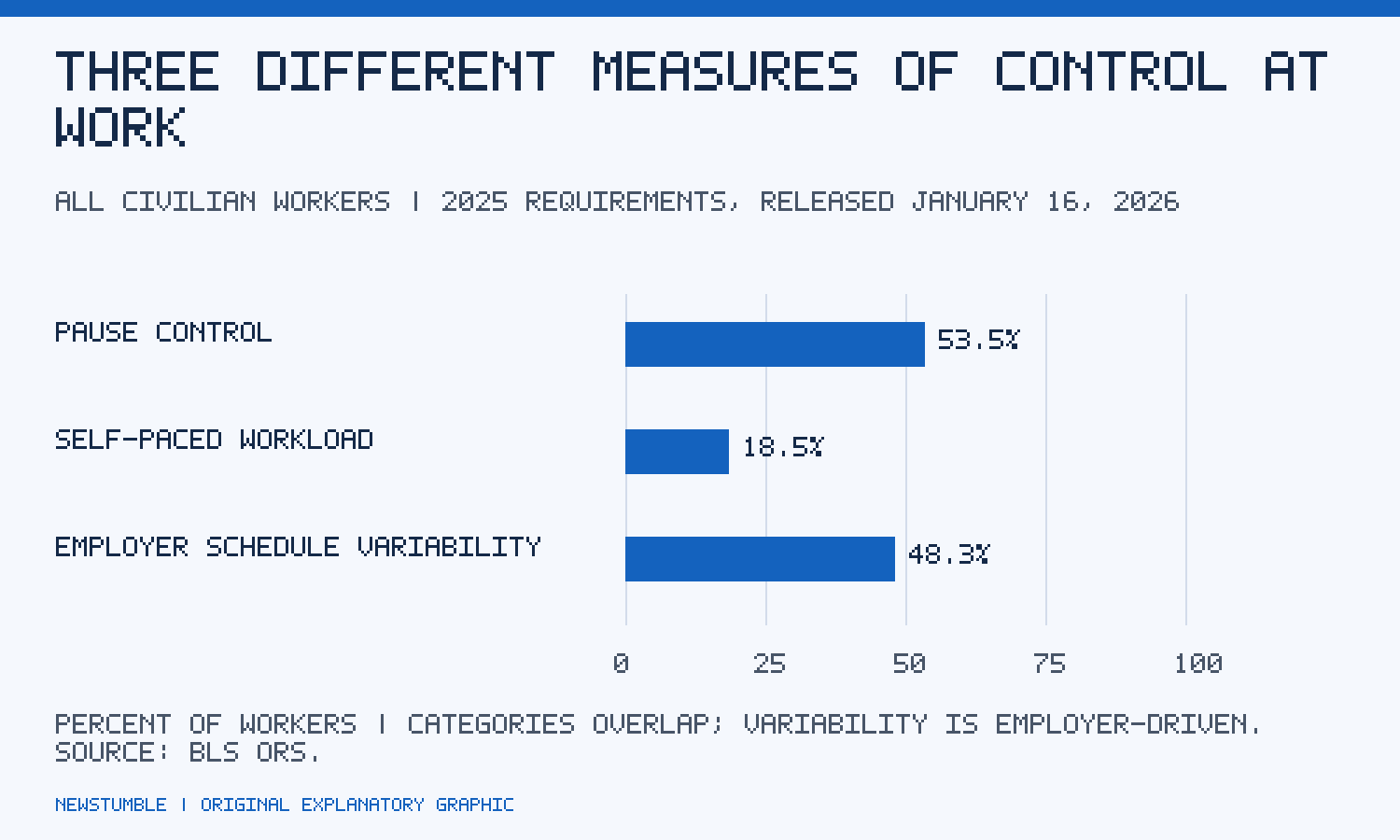
The Bureau of Labor Statistics’ January 16, 2026 release found that 53.5% of civilian workers had the ability to take short, unscheduled breaks in 2025, while 18.5% had a self-paced workload. Those measures describe different kinds of control on the job. Pause control does not establish discretion over the overall workload. [1] [2]
BLS defines self-paced work as mostly self-directed within general performance guidelines, allowing discretion over task timing within limits. The distinction appears clearly among electricians: 62.6% had pause control, but 0.7% had self-paced work. These are occupational estimates of job requirements; they do not describe every electrician’s individual arrangement. [1]
Schedule variability is a third measure, and it is easy to misread. BLS uses it for an employer changing reporting days, times or weekly hours. It was present for 48.3% of workers and 65.1% of electricians. In this dataset, a varying schedule therefore does not establish that a worker can choose a flexible schedule. [1]
The survey’s methods explain why those distinctions matter beyond a headline percentage. ORS is conducted under an agreement with the Social Security Administration and supplies information used by jobseekers, vocational experts, researchers and the disability community. BLS says the estimates describe requirements without workplace accommodations. They cannot by themselves determine what an individual could do with a particular adjustment. For collection, BLS says it typically speaks with someone who knows the job requirements, such as a human-resources representative, risk manager or supervisor; a written job description alone does not provide a complete assessment. [2]
The population is also bounded. Civilian workers here combine private-industry and state and local government workers, excluding federal, military, agricultural, household and self-employed workers. The annual estimates do not supply demographic, earnings or geographic breakdowns. Consequently these tables cannot establish a racial disparity in job control or tell readers which local employers offer it. [2]
The 2025 estimates are preliminary and combine two samples in the third collection wave, according to BLS’s reference explanation. Standard errors are available to help assess precision. For practical comparisons, readers need the same requirement definition, occupational category and coverage—not just two percentages bearing a job title. The release measures requirements in 2025; its January 2026 publication date is separate. [1] [2]
The source
- U.S. Bureau of Labor Statistics: Occupational Requirements in the United States — 2025 ↗
Source published 2026-01-16 · reviewed October 25, 2026 - U.S. Bureau of Labor Statistics: Occupational Requirements Survey: Questions and Answers ↗
Undated reference · reviewed October 25, 2026 · No publication date is given on this reference; page modification date is not treated as publication date.
About this item: Retrospective report. No first-hand reporting or independent testing is claimed. Corrections policy.