UN AI appointments staffed an evidence body
Retrospective: Forty experts were appointed in February 2026; policy decisions sit elsewhere.
- Event / announcement date
- 2026-02-12
- Earliest linked source date
- 2026-02-13T15:58:55+00:00
- NewsTumble first published
- 2026-10-26T15:32:22Z
- NewsTumble updated
- 2026-10-26T15:32:22Z
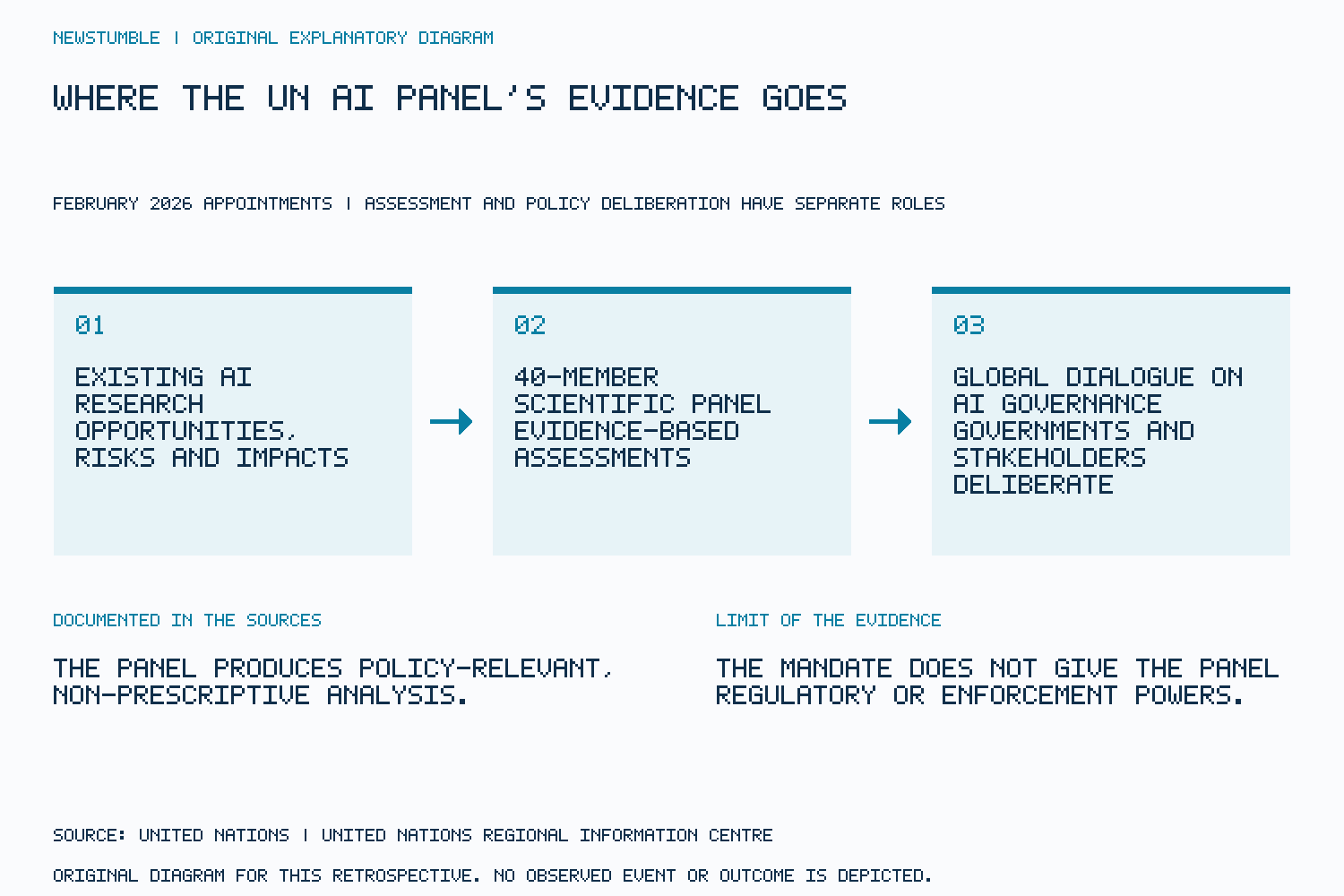
The UN General Assembly appointed forty AI scientific-panel members on February 12, 2026, for terms ending February 11, 2029. UNRIC’s next-day account recorded 117 votes in favour, two against and two abstentions. The vote staffed an evidence-assessment body, not a global regulator. [1]
The UN’s FAQ traces the panel to Resolution 79/325 of August 26, 2025, following the 2024 Global Digital Compact. Its annual reports and possible thematic briefs synthesize research on AI opportunities, risks and impacts outside the military domain. [2]
The panel supplies assessments to the separate Global Dialogue, where governments and stakeholders deliberate. The FAQ denies the panel rule-setting, enforcement or policy-prescribing powers. Evidence can inform debate without creating binding rules. [2]
The FAQ promises simultaneous assessment access across countries. That distribution mechanism does not establish equal capacity to act. Uruguay, speaking for the Group of 77 and China, called at the appointment meeting for fair developing-country inclusion. [1] [2]
The United States objected to mandate overreach and voted against the list, as did Paraguay. The UK called for public procedures on evidence, report-writing and disagreement. Those are attributed positions, not proof of either institutional independence or its absence. [1]
The official timeline subsequently listed a March 3 virtual plenary, an April 22–24 Madrid meeting and a July 1 preliminary-report launch before a July presentation in Geneva. These are listed meetings and outputs, not evidence that governments changed policy. Assessing influence requires different evidence from confirming that appointments and subsequent work were recorded. [3]
The source
- United Nations Regional Information Centre: General Assembly Appoints Artificial Intelligence Panel ↗
Source published 2026-02-13T15:58:55+00:00 · reviewed October 25, 2026 · Page date 13/02/2026 and JSON-LD datePublished 2026-02-13T15:58:55+00:00; covered appointment occurred 12 February. - United Nations: FAQ | Independent International Scientific Panel on AI ↗
Undated reference · reviewed October 25, 2026 · No publication date is given on this context reference. Historical dates and dates of listed events are not its publication date. - United Nations: Timeline | Independent International Scientific Panel on AI ↗
Undated reference · reviewed October 25, 2026 · No publication date is given on this context reference. Historical dates and dates of listed events are not its publication date.
About this item: Retrospective report. No first-hand reporting or independent testing is claimed. Corrections policy.