EPUB’s July test milestone put readable-book discovery alongside conformance
The candidate accessibility specification distinguished describing a book’s usable modes from certifying its content, building on earlier metadata work.
- Event / announcement date
- 2026-07-21
- Earliest linked source date
- 2024-10-17
- NewsTumble first published
- 2026-10-26T17:11:49Z
- NewsTumble updated
- 2026-10-26T17:11:49Z
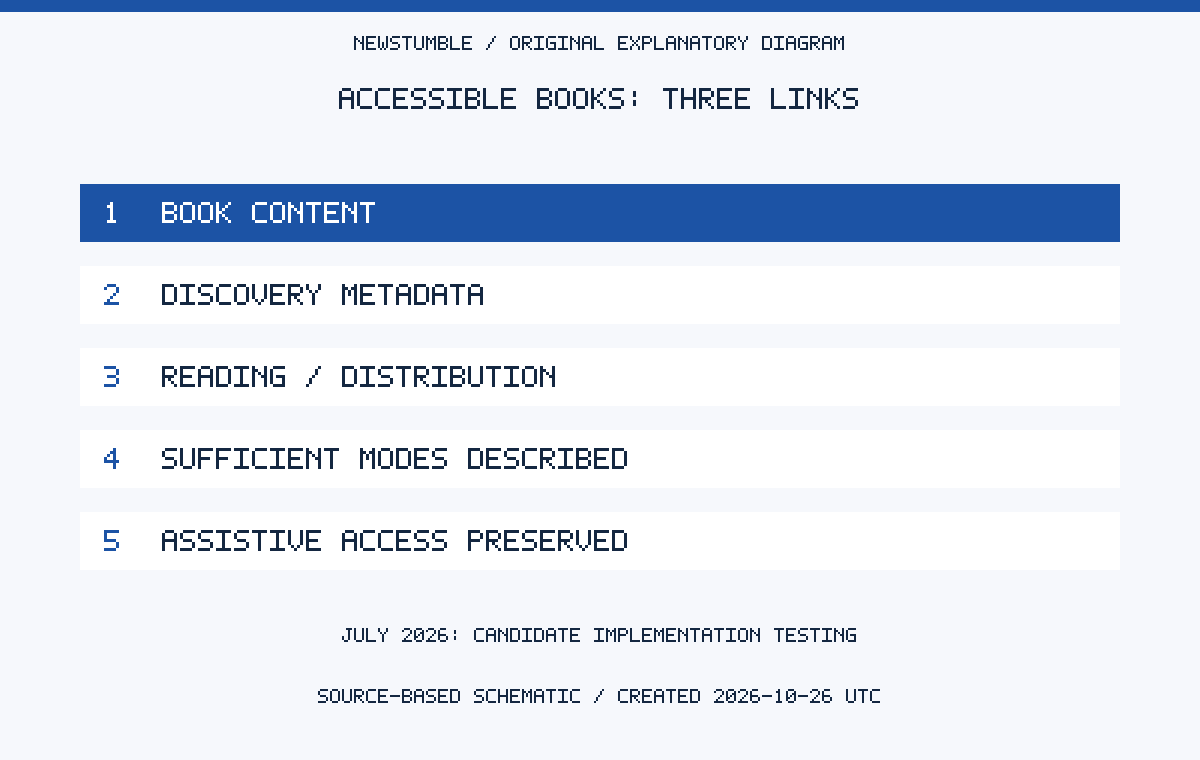
On July 21, 2026, W3C invited implementations of Candidate Recommendation Snapshots for EPUB 3.4, EPUB Reading Systems 3.4 and EPUB Accessibility 1.2. The connected documents addressed digital books, their reading software and accessibility information. This was a testing milestone, not proof that reading services had changed. [1]
EPUB Accessibility 1.1 was already a Recommendation in October 2024. It required books to expose accessibility metadata even when they did not meet separate accessibility requirements. Describing usable characteristics and declaring conformance were different tasks. [2]
Version 1.1 required the sensory modes needed to perceive content, along with accessibility features and hazards. It only recommended describing combinations of modes sufficient to consume the book without significant information loss. That field accounts for alternatives, such as transcripts for audio. [2]
The July 1.2 snapshot required sufficient-mode information and recommended the general access-mode field. Its change log dates that decision to June 26, 2025: July did not invent the metadata change, but brought the revised package to implementation testing. [3]
The intended reader benefit is information before acquisition: a service can expose which combination of modes makes a book usable. The snapshot warns that accessible content alone cannot ensure accessible distribution. Discovery, metadata access and restrictions preventing assistive reading remain separate barriers. [3]
The announcement’s October 19 comment deadline has passed. The snapshot said candidate publication did not imply W3C endorsement and sought implementation experience. These documents do not measure library adoption or how many readers gained access. [1] [3]
The source
- World Wide Web Consortium: W3C Invites Implementations of EPUB 3.4, EPUB Reading Systems 3.4 and EPUB Accessibility 1.2 ↗
Source published 2026-07-21 · reviewed October 25, 2026 · explicit document dateline - World Wide Web Consortium: EPUB Accessibility 1.1 — Recommendation, October 17, 2024 ↗
Source published 2024-10-17 · reviewed October 25, 2026 · explicit document dateline - World Wide Web Consortium: EPUB Accessibility 1.2 — Candidate Recommendation Snapshot, July 21, 2026 ↗
Source published 2026-07-21 · reviewed October 25, 2026 · explicit document dateline
About this item: Retrospective report. No first-hand reporting or independent testing is claimed. Corrections policy.