WCAG-EM 2.0 widened accessibility evaluation beyond web pages
The July Group Note explained a process for apps and other digital products while preserving the limits of sampling and automated checks.
- Event / announcement date
- 2026-07-23
- Earliest linked source date
- 2014-07-10
- NewsTumble first published
- 2026-10-26T17:11:49Z
- NewsTumble updated
- 2026-10-26T17:11:49Z
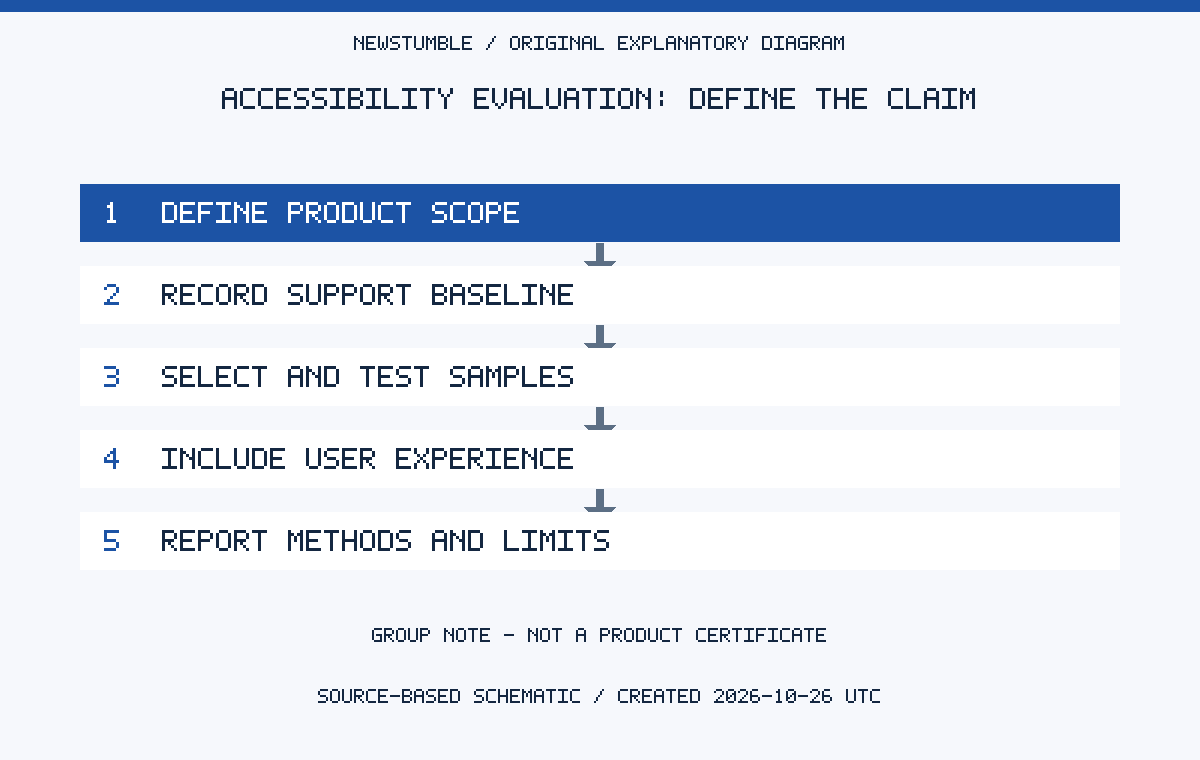
W3C published WCAG Evaluation Methodology 2.0 as a Group Note on July 23, 2026. Its announcement extended the approach beyond websites and pages to apps and other digital products, explaining how evaluators could assess conformance to WCAG 2. [1]
The July 2014 methodology had focused on websites. It already distinguished representative samples from whole-site claims and warned that the methodology alone generally did not establish conformance. Expansion to new products did not remove that limit. [2]
Version 2.0 puts the product boundary first: scope includes views, states and functions. Selectively excluding difficult parts can distort an assessment. For native or hybrid apps, samples may be identified by screenshots or routes to screens rather than web addresses. [3]
Evaluators also record an accessibility-support baseline: the browsers, assistive technologies and software combinations in scope. WCAG does not prescribe one universal combination. The baseline tells readers which environment an assessment addresses, instead of implying that one successful combination proves all others. [3]
W3C’s user-evaluation guidance explains why standards checks are insufficient alone: disabled and older participants can identify usability problems they miss. It recommends combining user involvement with conformance assessment. One participant cannot represent everyone sharing a disability, and a small study cannot establish statistical significance. [4]
The Group Note says most accessibility checks cannot be fully automated. Tools can help select samples and support human evaluation. The method organizes evidence; its publication does not certify an app or demonstrate that disabled users’ barriers have disappeared. [1] [3]
The source
- World Wide Web Consortium, Web Accessibility Initiative: WCAG Evaluation Methodology (WCAG-EM) 2.0 — Note Published ↗
Source published 2026-07-23 · reviewed October 25, 2026 · explicit document dateline - World Wide Web Consortium: Website Accessibility Conformance Evaluation Methodology (WCAG-EM) 1.0 ↗
Source published 2014-07-10 · reviewed October 25, 2026 · explicit document dateline - World Wide Web Consortium: WCAG Evaluation Methodology (WCAG-EM) 2.0 — Group Note, July 23, 2026 ↗
Source published 2026-07-23 · reviewed October 25, 2026 · explicit document dateline - World Wide Web Consortium, Web Accessibility Initiative: Involving Users in Evaluating Web Accessibility ↗
Undated reference · reviewed October 25, 2026 · No publication date is given for this context source. No exact original publication date is given: the reference says First published November 2005. It gives a June 1, 2021 content update and April 30, 2024 links update; none is treated as a new event or invented original day.
About this item: Retrospective report. No first-hand reporting or independent testing is claimed. Corrections policy.