The Library's new finding-aids interface changed discovery, not every access condition
Retrospective report: the February 2026 ArchivesSpace launch improved a route into special collections. Researchers still need to distinguish a collection guide from digitized material and a retrieval request.
- Event / announcement date
- 2026-02-02
- Earliest linked source date
- 2026-03-23
- NewsTumble first published
- 2026-10-26T06:04:58Z
- NewsTumble updated
- 2026-10-26T06:04:58Z
The Library of Congress completed the first phase of its ArchivesSpace project on February 2, 2026, unveiling a public interface for finding aids to archives, manuscripts and associated digital objects. The Library reported the completed launch in a March 23 account. For journalists and other primary-source researchers, the change offered a revised route into collection descriptions, rather than a promise that every item described had become available online. [1] [2]
The new interface replaced the previous site while retaining findingaids.loc.gov as its address. The Library described browsing by reading room, collection, subject and name, and said the platform would support additional search, filtering and digital-material browsing functions. Those statements distinguish the completed interface launch from functionality described prospectively. The help guide separately confirms that the replacement public interface was released in February. [1] [3]
The useful distinction is between a catalog entry and a finding aid. The Library explains that special collections are generally cataloged as groups rather than with a separate record for each item. A finding aid goes further, supplying an inventory arranged within a collection and information about its origins. That structure helps a researcher move from the name of a collection toward the boxes, files or other materials relevant to a question. [2]
It also carries context that a search result can omit. The Library says archival descriptions explain provenance, collection scope, related people and organizations, and conditions for access or copying. Not every collection has a finding aid, and some guides remain available only in print in reading rooms. Absence from the online guide system therefore is not proof that the Library holds no relevant material. [2]
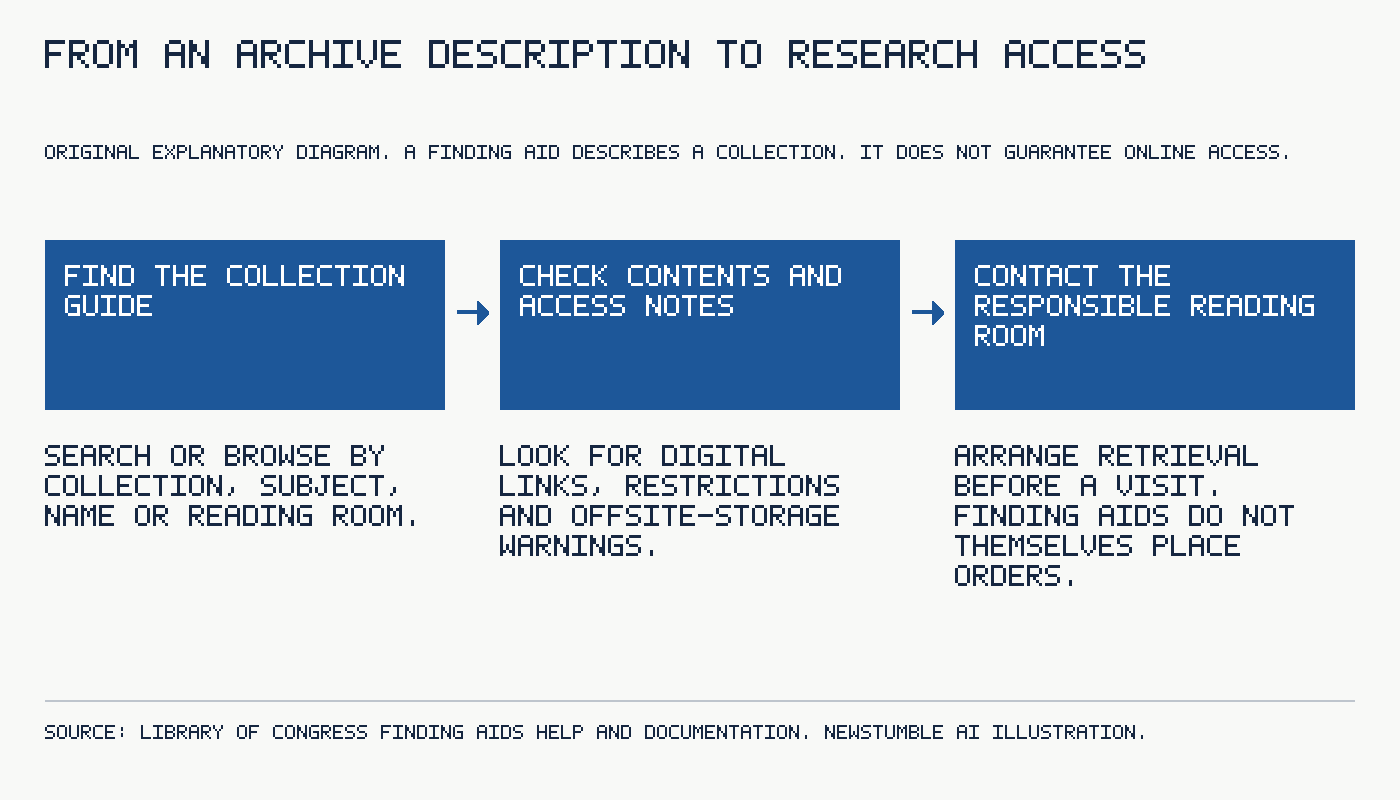
Digital access is a separate question. The understanding guide says a digital-object record can indicate associated digital materials and generally link to them on the Library’s digital-collections platform. Other finding aids may warn of access restrictions or offsite storage. A searchable description is useful evidence about a collection, but is not itself a scan of its contents or permission to reproduce them. [2]
The requesting guide supplies a practical next step: archival materials cannot be ordered through the catalog or the finding aids. Researchers are advised to contact the relevant reading room or research center before visiting, including to arrange retrieval of offsite containers or clarify restrictions. The new discovery interface does not remove that institutional handoff. [4]
The Library documented a completed replacement of its collection-discovery interface, with access still governed by the material and its custodial unit. This retrospective did not test the interface or measure research outcomes. It identifies what the Library said had launched and the concrete limits that remain important when using historical records as sources. [1] [4]
The source
- Library of Congress: What’s New Online at the Library of Congress: March 2026 ↗
Source published 2026-03-23 · reviewed October 25, 2026 · Actual displayed publication date; old context dates are not the new event. - Library of Congress: Understanding Finding Aids ↗
Undated reference · reviewed October 25, 2026 · No publication date is given for this context reference. Its Last Updated marker is not used as a publication date. - Library of Congress: Welcome to the Library of Congress Finding Aids Help Guide! ↗
Undated reference · reviewed October 25, 2026 · No publication date is given on this context reference; its Last Updated marker is not substituted. - Library of Congress: Requesting Material ↗
Undated reference · reviewed October 25, 2026 · No publication date is given for this context reference. Its Last Updated marker is not used as a publication date.
About this item: Retrospective report. No first-hand reporting or independent testing is claimed. Corrections policy.