Local news goes online, including work from newspapers and TV stations
Pew’s local-news figures separate the organizations producing information from the screens delivering it—and show how few adults have spoken with a journalist.
- Event / announcement date
- 2026-04-14
- Earliest linked source date
- 2026-04-14
- NewsTumble first published
- 2026-10-26T03:29:20Z
- NewsTumble updated
- 2026-10-26T04:05:34Z
Updated October 25, 2026 · Added a closing distinction between delivery platforms and reporting organizations, and clarified that reported reach and journalist contact do not establish thorough community coverage or effective channels for residents’ concerns.
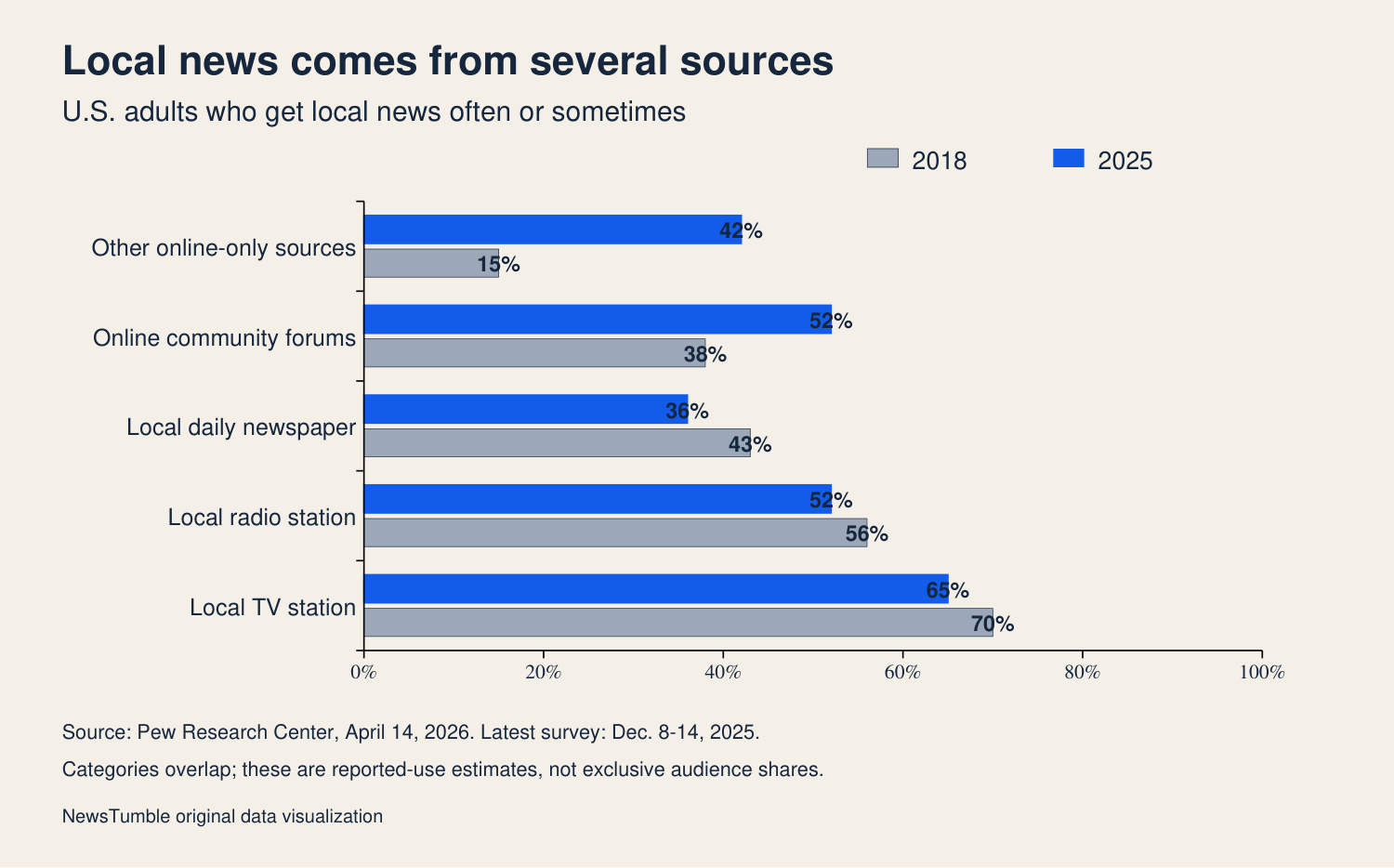
Pew’s April 14, 2026 local-news release showed established news organizations coexisting with newer digital routes. In its December 8–14, 2025 survey, 65% of U.S. adults said they got local news and information from a local TV station often or sometimes; 52% used local radio and 36% a daily newspaper. Understanding that picture requires distinguishing the producer from the screen. [1]
Among users of a local daily newspaper, 68% primarily got its news online in 2025, compared with 43% in 2018. Among local-TV users, the online share rose from 22% to 43%. These figures concern each outlet type’s users, rather than all adults. Both producers distribute through websites, apps, email and social posts. [2]
Other online-only sources reached 42% of adults, up from 15% in 2018. But Pew explicitly excluded sources already counted in earlier categories from that label. Online community forums reached 52%, and local government agencies or officials reached 40%. News influencers reached 36%, but that question began in 2025, so the chart supplies no earlier influencer trend. These are overlapping information routes, not exclusive shares to add together. [1]
Close attention is a separate measure. Twenty-one percent followed local news very closely in 2025, down from 37% in 2016; 80% considered local outlets at least somewhat important to their community. Occasional use therefore does not establish sustained attention. [2]
Only 23% had ever spoken with a local journalist: 30% of college graduates and 17% of adults with a high-school education or less. These differences identify unequal reported contact without establishing why it occurred or whose concerns were covered. The survey maps habits and contact; it does not independently assess the accuracy or completeness of information received. [2]
For readers, separating the delivery platform from the reporting organization helps identify who produced an item and whom to approach with questions. A story encountered on social media can still originate in a newspaper or TV newsroom. Pew’s reach and contact measures do not establish whether a community’s concerns are covered thoroughly or whether residents have effective ways to raise them with a newsroom; those questions require separate evidence about local reporting and newsroom responses. [1] [2]
The source
- Pew Research Center: Where Americans get local news ↗
Source published 2026-04-14 · reviewed October 25, 2026 - Pew Research Center: Local News Fact Sheet ↗
Source published 2026-04-14 · reviewed October 25, 2026
About this item: Retrospective report. No first-hand reporting or independent testing is claimed. Corrections policy.