NAIRR's operations-center announcement put the work of research access in focus
Retrospective report: NSF named institutions to coordinate shared AI resources. The pilot's application rules show why a portal alone does not guarantee access.
- Event / announcement date
- 2026-09-01
- Earliest linked source date
- 2024-01-24
- NewsTumble first published
- 2026-10-26T06:04:58Z
- NewsTumble updated
- 2026-10-26T06:04:58Z
The National Science Foundation announced on September 1, 2026, that it was establishing an operations center for the National Artificial Intelligence Research Resource. Led by the San Diego Supercomputer Center at UC San Diego, with the Texas Advanced Computing Center at the University of Texas at Austin, the center was assigned work that sits between an available computer and a usable research opportunity: coordinating providers, integrating resources and helping people use them. [1]
NSF's announcement described a national portal, user support, training and a transition of appropriate pilot functions into longer-term infrastructure. Those are assigned responsibilities, rather than evidence that every function was already operating. For researchers seeking shared AI infrastructure, a coordinating institution and a resource allocation are different decisions. [1]
The effort had a history before the new center. NSF launched the pilot on January 24, 2024, with federal, private, nonprofit and philanthropic partners. Its original structure separated open research, privacy-preserving work, software interoperability and classroom support. Access therefore involved computing and datasets alongside technical assistance and education, rather than a single undifferentiated pool of machines. [2]
By March 2026, NSF reported that the pilot had supported more than 600 research teams and 6,000 students across all 50 states, Washington, D.C., and Puerto Rico. Those agency-reported participation figures establish the program's reported reach. They do not by themselves measure whether institutions faced equal barriers or whether particular research projects succeeded. [3]
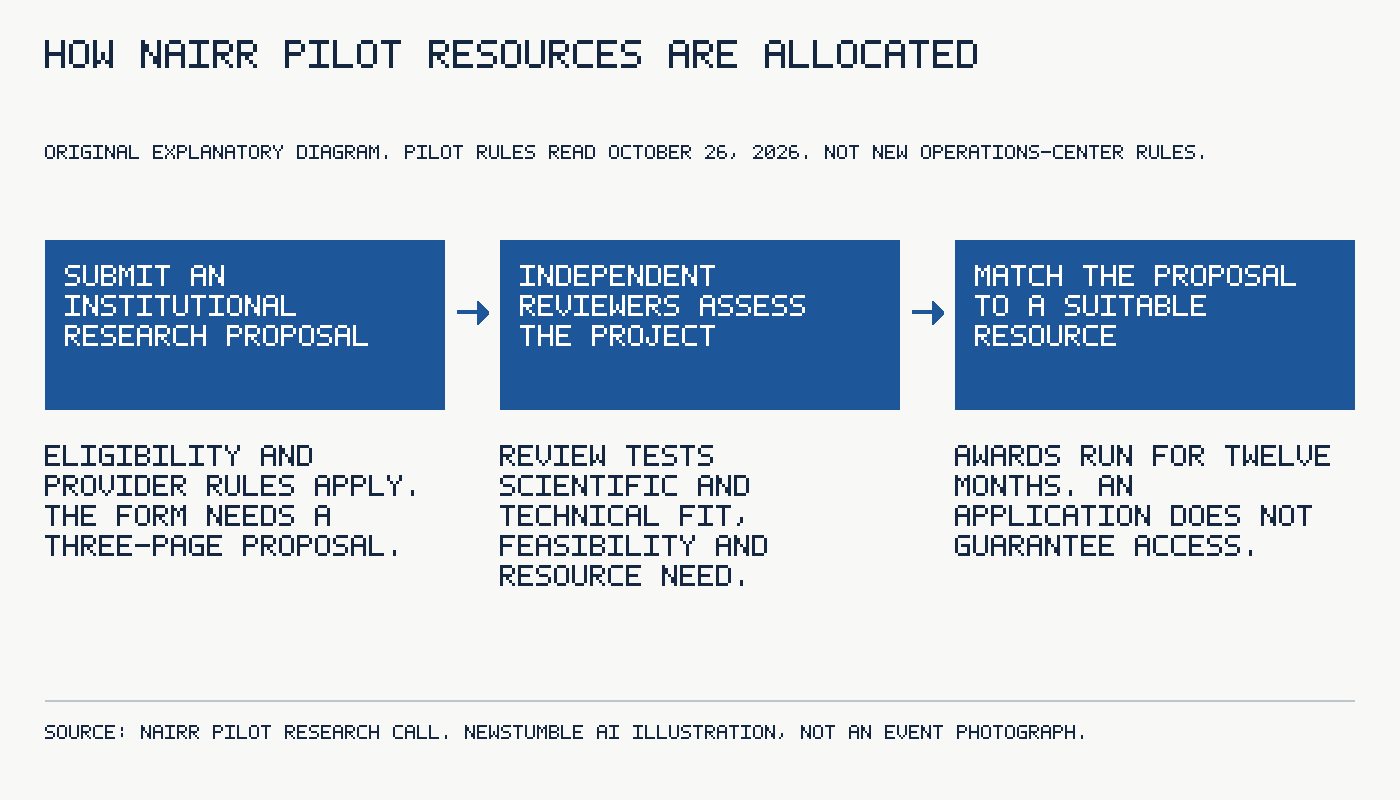
The research-resource call inspected for this retrospective explains the access mechanism. Applicants submit a form and a three-page proposal; independent reviewers assess scientific and technical suitability before committees match proposals to resources. Eligibility covers specified U.S.-based researchers and educators, but individual providers can impose different requirements. The call describes twelve-month awards and resources that can disappear as contributions are committed. [4]
There is also a consequential choice about who sees a proposal. The pilot says participating nongovernmental providers can see reviews in their resource category through matching committees, subject to confidentiality agreements. Applicants who choose only government resources can request that nongovernmental partners not see the submission, potentially narrowing matching options. This is a concrete tradeoff in a public-private access system, not evidence of misuse of proposals. [4]
These pilot instructions are an undated reference read for this report, not newly announced rules for the operations center. They show the review and matching work behind access. The September establishment notice does not demonstrate that the new organization eliminated allocation constraints or unequal institutional access; verifying those outcomes would require evidence beyond an organizational announcement. [1] [4]
The source
- National Science Foundation: NSF establishes operations center for the National Artificial Intelligence Research Resource ↗
Source published 2026-09-01 · reviewed October 25, 2026 · Actual displayed source publication date; event and retrieval dates remain separate. - National Science Foundation: Democratizing the future of AI R&D: NSF to launch National AI Research Resource pilot ↗
Source published 2024-01-24 · reviewed October 25, 2026 · Actual displayed source publication date; event and retrieval dates remain separate. - National Science Foundation: NAIRR at 2 years: Advancing American artificial intelligence innovation and leadership ↗
Source published 2026-03-19 · reviewed October 25, 2026 · Actual displayed source publication date; event and retrieval dates remain separate. - NAIRR Pilot: NAIRR Pilot Resource Requests to Advance AI Research ↗
Undated reference · reviewed October 25, 2026 · No publication date is given for this context reference. Any revision marker, historical call opening date or date in a news listing is not treated as its publication date.
About this item: Retrospective report. No first-hand reporting or independent testing is claimed. Corrections policy.