Two lasers help shrink a light-measuring tool toward portable clocks
A chip experiment addresses a barrier to compact frequency combs; navigation benefits remain a future possibility.
- Event / announcement date
- 2026-10-16
- Earliest linked source publication
- 2026-10-05
- NewsTumble first published
- 2026-10-25T21:29:13Z
- NewsTumble updated
- 2026-10-25T21:29:13Z
Researchers at NIST and the Joint Quantum Institute have demonstrated a new way to produce a miniature frequency comb, a tool that lets scientists compare light frequencies precisely. The advance could help reduce the equipment needed for optical atomic clocks, according to NIST’s October 16 report. It is a laboratory result, with portable applications still ahead. [1]
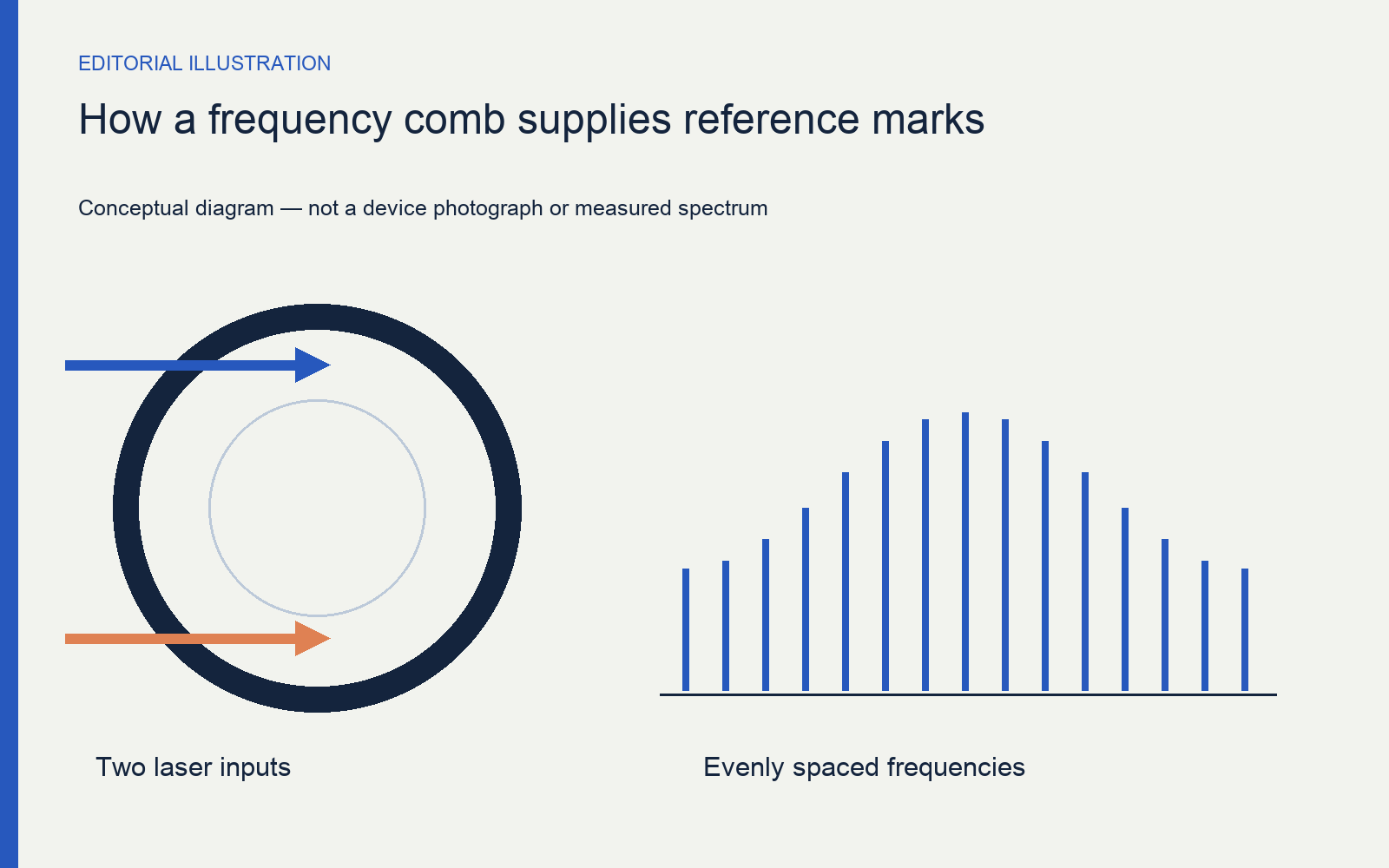
A frequency comb supplies regularly spaced reference frequencies, functioning like measurement marks for light. The team directed two lasers around a tiny ring on a chip. Their interactions produced a comb while addressing stability problems that can leave earlier designs dependent on additional equipment. That matters because shrinking the chip alone does not make an entire measurement system portable. [1]
The Joint Quantum Institute’s account describes how the new approach aligns overlapping frequency lines that had complicated an earlier two-laser demonstration. Researchers also tested one device in several measurement arrangements, including comparisons involving optical and microwave signals. Checks against a conventional tabletop comb helped establish that the miniature device could reproduce the relevant measurement performance under those experimental conditions. [2]
NIST identifies navigation when GPS is unavailable or disrupted as a possible use for future compact clocks. The immediate achievement is narrower: a component and a method that could support that work. The institute’s research account says further refinements are planned. Readers should therefore distinguish the demonstrated optical measurements from a finished clock or a navigation system proven in everyday service. [2]
The source
- NIST: New Chip-Based ‘Tape Measure’ for Light Could Revolutionize Mobile Timekeeping and Enhance National Security ↗
Source published 2026-10-16 · reviewed 2026-10-25 - Joint Quantum Institute: New Chip-Based Frequency Combs Demonstrate Potential for Portable Atomic Clocks ↗
Source published 2026-10-05 · reviewed 2026-10-25
About this item: Retrospective source brief. No first-hand reporting or independent testing is claimed. Corrections policy.