IFAB’s delay rules put possession and substitutions on the clock
Five-second restart countdowns and a ten-second exit rule have different triggers, penalties and exceptions.
- Event / announcement date
- 2026-02-28
- Earliest linked source date
- 2026-02-28
- NewsTumble first published
- 2026-10-26T05:22:38Z
- NewsTumble updated
- 2026-10-26T05:22:38Z
Football's lawmakers approved a new set of delay penalties on February 28, 2026, adding consequences that include loss of possession or a temporary wait for a substitute. At its meeting in Hensol, Wales, the International Football Association Board extended the countdown approach to throw-ins and goal kicks. Its stated purpose was to protect playing time; the decision itself did not measure whether matches subsequently became faster. [1]
The distinction for spectators is when the clock starts. Under the published countdown protocol, a referee who determines that a team is deliberately delaying a restart blows the whistle, signals and counts down five seconds with a raised hand. This is a response to delay, rather than a five-second limit automatically running from every occasion the ball leaves play. A prior verbal instruction to hurry is optional. [3]
If the ball is still not in play when that count ends, a throw-in changes hands at the same location. A delayed goal kick becomes an opposing corner on the nearer side. The referee can begin counting before the player possesses the ball, including when retrieval or positioning causes deliberate delay. The protocol also says not to punish someone already making the throw or kick as the count ends. [3]
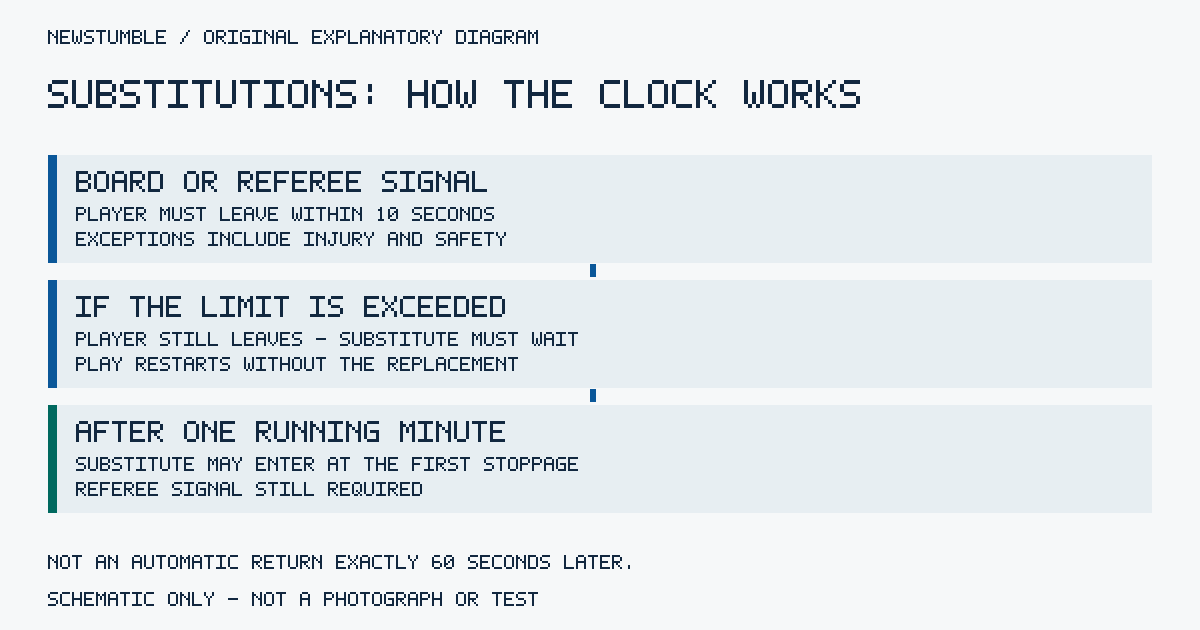
Substitutions use a different sequence. The outgoing player normally has ten seconds after the board or referee's signal to leave, usually at the nearest boundary. If that limit is exceeded, the player must still go, but the replacement waits outside as play restarts. Entry becomes possible only at the first stoppage after one running minute, with the referee's signal. Waiting exactly 60 seconds is therefore insufficient if play continues. [2]
The detailed substitution protocol preserves discretion for injury and safety. A referee may waive the time limit when an injury clearly prevents a timely exit or the nearest boundary is unsafe. It also allows entry when the outgoing player is already very close to, or crossing, the line as the count ends. Exceeding ten seconds does not automatically produce a yellow card: the protocol reserves that caution for excessive delay. [2]
The February announcement placed these changes alongside a July 1 effective date for the 2026/27 Laws, allowing earlier adoption by competitions beginning beforehand. The detailed protocols remain published in that edition, providing operational follow-through beyond the meeting announcement. These sources explain the rules and the officials' responsibilities; they do not establish consistent enforcement in every competition or quantify additional minutes of play. [1] [2] [3]
The source
- The International Football Association Board: The IFAB introduces further measures to improve match flow and player behaviour ↗
Source published 2026-02-28 · reviewed October 25, 2026 · explicit source dateline - The International Football Association Board: Time-limited substitution protocol ↗
Undated reference · reviewed October 25, 2026 · No publication date is given on this context reference. Retrieval time is not a publication date. - The International Football Association Board: Throw-in and goal-kick countdown protocol ↗
Undated reference · reviewed October 25, 2026 · No publication date is given on this context reference. Retrieval time is not a publication date.
About this item: Retrospective report. No first-hand reporting or independent testing is claimed. Corrections policy.