Ski mountaineering's first Olympic sprints put transitions alongside climbing speed
Fatton and Cardona Coll won the February 19 races in Bormio, as a compact Olympic format showcased only part of the sport's competition system.
- Event / announcement date
- 2026-02-19
- Earliest linked source date
- 2026-02-19
- NewsTumble first published
- 2026-10-26T12:03:04Z
- NewsTumble updated
- 2026-10-26T12:03:04Z
Switzerland's Marianne Fatton and Spain's Oriol Cardona Coll won the first Olympic ski-mountaineering sprint titles in Bormio on February 19, 2026. The International Ski Mountaineering Federation reported Fatton's winning time as 2:59.77 and Cardona Coll's as 2:34.03. Their races introduced an Olympic audience to a discipline in which the climb, equipment changes and descent all belong to the timed competition. [1] [2]
France's Emily Harrop took women's silver, 2.38 seconds behind Fatton, and Spain's Ana Alonso Rodriguez took bronze, 10.45 seconds back, according to the federation. In the men's final, individual neutral athlete Nikita Filippov finished second in 2:35.55, with France's Thibault Anselmet third in 2:36.34. These are results from separate sprint finals; comparing the men's and women's winning times does not by itself rank performances across the two competitions. [1] [2]
The federation's women's-race account locates the decisive change at a transition. Harrop led early; Fatton moved ahead while removing the climbing skins, then held the advantage on the descent. This explains why a sprint in the sport is more than an uphill running contest. Time spent changing the equipment's configuration is part of the contest, not a pause between its main phases. The account identifies the maneuver but does not supply a separately timed transition split. [1]
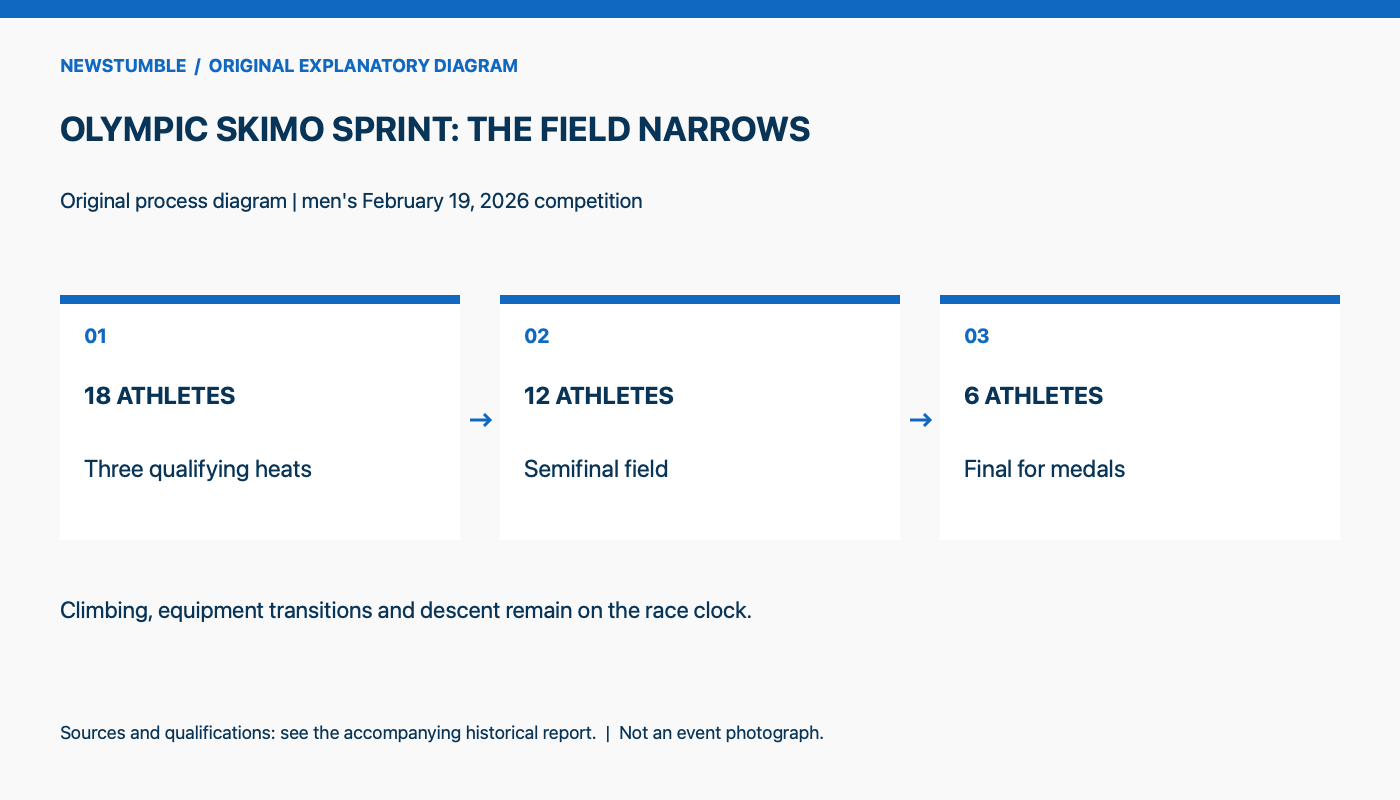
The men's course was 725 meters long with 70 meters of ascent and descent, ISMF reported. Eighteen men began in three qualifying heats; the field narrowed to twelve for semifinals and six for the final. Cardona Coll's final surge included the stepped climbing section and a transition before the finish. Moving through successive rounds made both qualification and the final race relevant; the first heat's time alone did not award a medal. [2]
The Olympic selection was narrower than ski mountaineering as a whole. ARISF's account records three medal events and 36 athletes, evenly split between women and men, with a mixed relay following the two sprints on February 21. It also distinguishes the sport's Individual, Vertical and Team races from Sprint and Mixed Relay. The debut therefore provided access to Olympic competition through a compact set of disciplines, rather than bringing the entire international programme onto the Olympic schedule. The retrieved sources document those races and formats, not later participation growth or an expansion of community facilities. [3]
The source
- International Ski Mountaineering Federation: Marianne Fatton makes history as the first-ever Olympic gold medallist of Skimo - ISMF ↗
Source published 2026-02-19 · reviewed October 25, 2026 · Date appears in the source release, dated statement, or Federal Register document; not taken from related-news lists. - International Ski Mountaineering Federation: Oriol Cardona wins historic first Olympic men’s Ski Mountaineering sprint gold - ISMF ↗
Source published 2026-02-19 · reviewed October 25, 2026 · Date appears in the source release, dated statement, or Federal Register document; not taken from related-news lists. - Association of IOC Recognised International Sports Federations: Historic Debut for the International Ski Mountaineering Federation at the Milano Cortina Olympic Games - ARISF ↗
Undated reference · reviewed October 25, 2026 · No publication date is given on this context reference. Event dates, document title years and last-updated labels are not treated as original publication dates.
About this item: Retrospective report. No first-hand reporting or independent testing is claimed. Corrections policy.