CPSC’s September rule removal retained antenna and appliance warnings
The final rule distinguishes old helmet provisions, CFC labels and routine submissions to the agency from the safety information consumers still receive.
- Event / announcement date
- 2026-09-21
- Earliest linked source date
- 2026-07-23
- NewsTumble first published
- 2026-10-26T13:02:50Z
- NewsTumble updated
- 2026-10-26T13:02:50Z
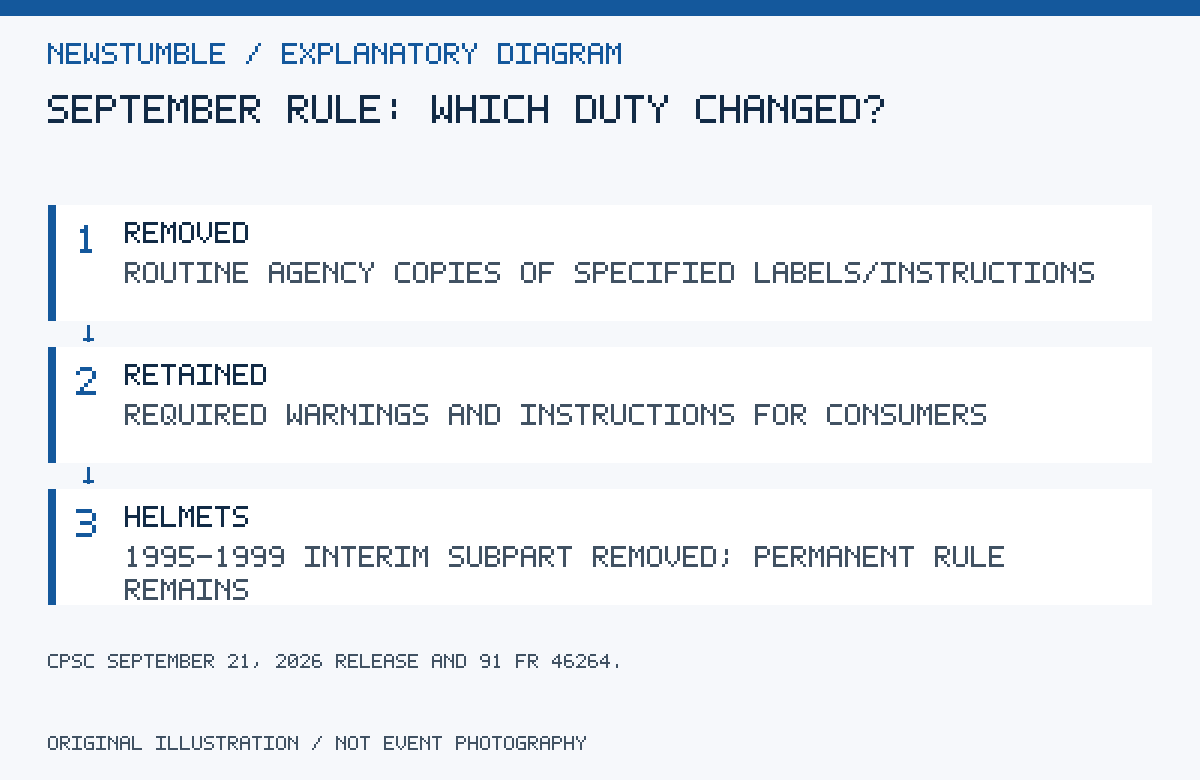
On September 21, 2026, CPSC said its rule deleting obsolete provisions had taken effect. It affected interim helmet rules, CFC aerosol warnings and routine label filings for antennas and solid-fuel appliances. [1]
Manufacturers and importers no longer had to send the agency routine copies of warnings and instructions for covered CB/TV antennas and coal- or wood-burning appliances. They must still supply applicable safety information to consumers, and CPSC retains authority to request the documents. [1]
The Federal Register text supplies the underlying hazard history. Antenna requirements addressed electrocutions when outdoor antennas contacted overhead power lines during installation or removal. Appliance requirements addressed fires connected with inadequate information about installation, clearance from combustibles and operation. Removing routine agency submissions leaves the substantive consumer-warning duties in those parts unchanged, according to the rule. [2]
For helmets, the removed subpart covered manufacture from March 17, 1995 through March 10, 1999. A permanent standard covers helmets manufactured after March 10, 1999, and the rule says its remaining requirements were unchanged. The date boundary explains why removing an interim provision does not mean newly manufactured bicycle helmets lost their safety standard. [2]
CPSC’s separate helmet guidance explains what the continuing performance system tests: peripheral vision, whether a helmet stays on, strap strength and reduction of impact force. It also describes conditioning samples in heat, cold and water before testing. Those laboratory requirements address different failure modes, including a helmet coming off before it can protect a rider during an impact. [3]
The scope follows how a helmet is marketed. The guidance says equipment promoted as protecting a bicycle rider, including some multipurpose products, falls within the bicycle-helmet definition. Equipment marketed exclusively for other listed activities is treated differently. This is a description of the regulator’s classification system, not a recommendation that a particular household’s helmet fits correctly or is safe for every activity. [3]
The action also removed a point-of-purchase CFC warning after other regulation largely eliminated the relevant products. CPSC reported no significant adverse comments. Its no-loss-of-protection claim was an agency judgment about these deletions, not a later evaluation of injury rates or enforcement. [1]
The source
- U.S. Consumer Product Safety Commission: CPSC Continues Elimination of Outdated and Unnecessary Regulations | CPSC.gov ↗
Source published 2026-09-21 · reviewed October 25, 2026 · explicit-source-date - U.S. Consumer Product Safety Commission / Federal Register: Removal of Obsolete or Unnecessary Requirements, 91 FR 46264 ↗
Source published 2026-07-23 · reviewed October 25, 2026 · explicit-source-date - U.S. Consumer Product Safety Commission: Bicycle Helmets Business Guidance | CPSC.gov ↗
Undated reference · reviewed October 25, 2026 · No publication date is given. No publication date is given on this business guidance reference.
About this item: Retrospective report. No first-hand reporting or independent testing is claimed. Corrections policy.