An Indigenous-language book collection made selection and circulation part of reading access
UNESCO’s July 2026 account identified nearly 170 books; the programme’s rules show how titles reached the collection and where copies were meant to travel.
- Event / announcement date
- 2026-07-30
- Earliest linked source date
- 2025-03-31
- NewsTumble first published
- 2026-10-26T13:02:50Z
- NewsTumble updated
- 2026-10-26T13:02:50Z
UNESCO reported on July 30, 2026 that its collection with the International Board on Books for Young People contained nearly 170 children’s titles in more than 150 Indigenous and endangered languages, selected from over 500 submissions. It gave readers and librarians a route to discover work across publishing systems. [1]
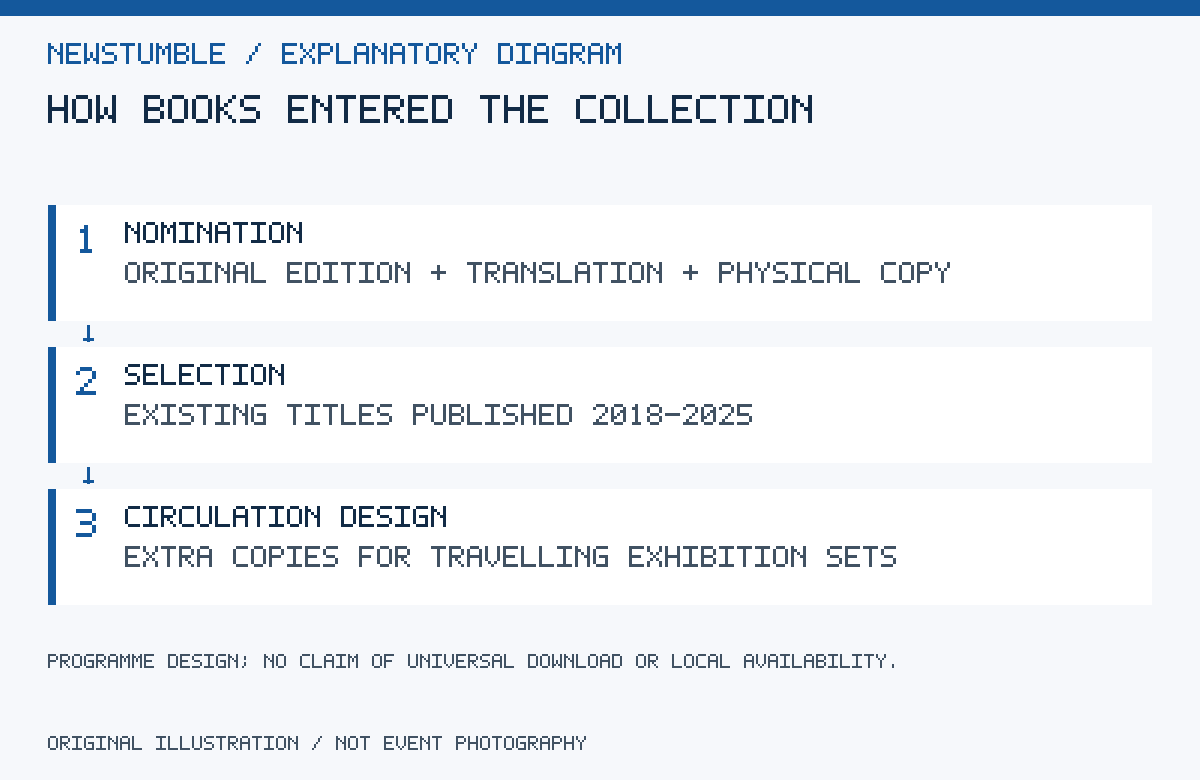
Eligibility covered original Indigenous- or endangered-language editions and original bilingual books containing one. Fiction, nonfiction and illustrated forms qualified under literary or artistic standards. Works had to have been published from January 2018 through December 2025. [2]
Publishers, IBBY sections and other competent institutions could nominate up to three titles per language. Each required the digital original, cover, English/French/Spanish translation and physical copy. These demands do not establish equal nomination capacity across communities. [2]
IBBY’s committee reference shows several kinds of expertise involved. Its members include linguist Aïcha Belkadi, whose work concerns Amazigh languages, and Colette Poitras, a Métis public-library specialist. Jeannet Stephen’s biography describes community-driven Indigenous early-childhood education and language work in Sabah. Those backgrounds help explain the programme’s connection to language and library systems, without substituting committee membership for testimony from every represented community. [3]
The selected books make the range concrete. UNESCO names Tortoise and Ostrich, a folk tale in N|uu, and Tamarra, which explains termites in Gurindji Country in northern Australia. These are different kinds of reading material—storytelling and knowledge about a particular environment—rather than interchangeable translations of a single global text. UNESCO describes the collection as spanning seven Indigenous socio-cultural regions. [1]
Selected publishers were asked for three additional physical copies. Plans called for three touring sets and a permanent Paris library collection. Intended circulation does not establish universal local access or free digital reading. [2]
IBBY’s programme page now says submissions are closed, but still uses future tense for the planned Ottawa presentation and later fairs. The July selection was documented; touring arrangements remained programme design. Exhibition completion and effects on language transmission require separate distribution and use evidence. [1] [3]
The source
- UNESCO: A new collection celebrates children's books in Indigenous and ↗
Source published 2026-07-30 · reviewed October 25, 2026 · explicit-source-date - IBBY and UNESCO: IBBY-UNESCO Regulations 2025-2026, FINAL (upd 180925) ↗
Source published 2025-03-31 · reviewed October 25, 2026 · Issued March 31, 2025; updated September 18, 2025, both explicitly printed on page 4. Earlier context, not the in-window event. - IBBY: IBBY-UNESCO Collection of Remarkable Books in Indigenous and Endangered Languages: IBBY International Board on Books for Young People ↗
Undated reference · reviewed October 25, 2026 · No publication date is given. No publication date is given on this programme/selection-committee reference. It retains prospective wording, which is not completion proof.
About this item: Retrospective report. No first-hand reporting or independent testing is claimed. Corrections policy.