Folger’s Black women and Shakespeare exhibition follows the evidence beyond the stage
Manuscripts, costumes and archival gaps connect performance history with the collection practices that make some lives visible and others harder to recover.
- Event / announcement date
- 2026-10-16
- Earliest linked source date
- 2026-06-04
- NewsTumble first published
- 2026-10-26T14:04:38Z
- NewsTumble updated
- 2026-10-26T14:04:38Z
The Folger Shakespeare Library’s To Hear Her Speak: Black Women and Shakespeare brought nearly 100 objects into a survey beginning October 16, 2026. Curated by Patricia Akhimie, the exhibition connects Black women’s acting, writing, scholarship and visual art with research on their presence in early modern Europe. Its official gallery page lists the display through May 2, 2027, alongside selected objects and an audio guide. [1]
Akhimie’s catalog introduction treats Shakespeare as texts, performance, institutions and industry. That frame makes a manuscript, costume or scholarly argument evidence of different engagements, rather than limiting the history to who appeared on a stage. [2]
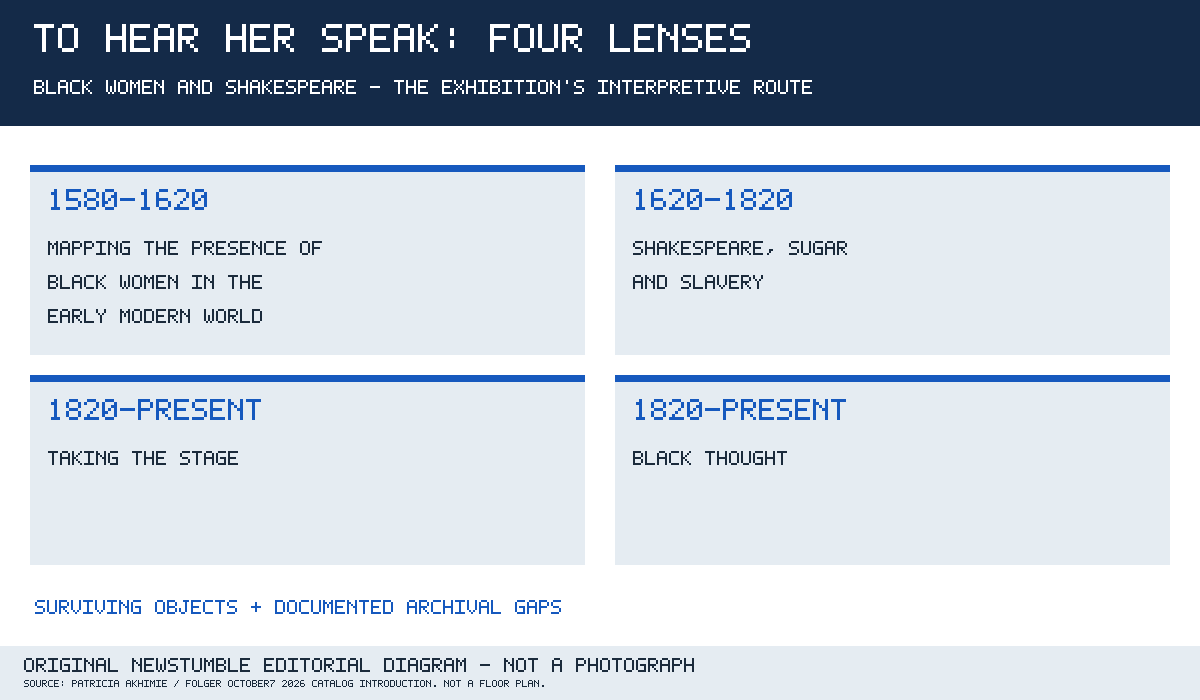
Four sections connect early modern London, slavery and collecting, performance, and Black thought. Akhimie situates the exhibition in scholarship on race and gender developed from the late twentieth century onward. The histories being interpreted did not begin when the galleries opened. [2]
The Folger’s announcement gave concrete examples of that interpretation. Toni Morrison’s handwritten notes for Desdemona and a playbill from Maya Angelou’s Macbeth production at Wake Forest University place writing and directing beside acting. Suzanne Coley’s bound, beaded and embroidered sonnet books connect Shakespeare with contemporary bookmaking. Such objects show how inherited text becomes new creative work across more than one medium. [3]
The catalog’s final essays discuss objects known to have existed that were lost or never preserved. Such gaps limit the surviving account. Preservation and documentation are therefore part of the exhibition’s subject, alongside the creative works that remain. [2]
For visitors, the interpretation includes an audio guide narrated by actor and director Adjoa Andoh, with commentary from Akhimie, Kim F. Hall and Joyce Green MacDonald. The gallery page recommends bringing headphones and says a limited number of devices can be borrowed, with free Wi-Fi available. Admission is free, with a recommended $15 donation; that recommendation is not the stated entry price. [1]
The June announcement also described a reading area functioning as a small archive and an interactive table for writing and copying inspirational texts. Video displays would connect creative commentary with recorded performances. These are the institution’s stated interpretive methods: giving visitors different ways to examine text, making and performance. This reporting has not independently tested each installation. [3]
The source
- Folger Shakespeare Library: To Hear Her Speak: Black Women and Shakespeare | Folger Shakespeare Library ↗
Undated reference · reviewed October 25, 2026 · No publication date is given on this context reference. Retrieval is not publication. - Folger Shakespeare Library: To Hear Her Speak: Black women, Shakespeare, and early modern texts | Folger Shakespeare Library ↗
Source published 2026-10-07 · reviewed October 25, 2026 · publication date displayed in source body - Folger Shakespeare Library: Press Release: Folger Announces Major Exhibition - To Hear Her Speak ↗
Source published 2026-06-04 · reviewed October 25, 2026 · publication date displayed in source body
About this item: Retrospective report. No first-hand reporting or independent testing is claimed. Corrections policy.