EES’s April milestone changed border records; implementation still varied
Digital entry and exit records replaced passport stamps in the system’s full-operation phase, while later official accounts described uneven processing.
- Event / announcement date
- 2026-04-10
- Earliest linked source date
- 2026-04-10
- NewsTumble first published
- 2026-10-26T17:11:49Z
- NewsTumble updated
- 2026-10-26T17:11:49Z
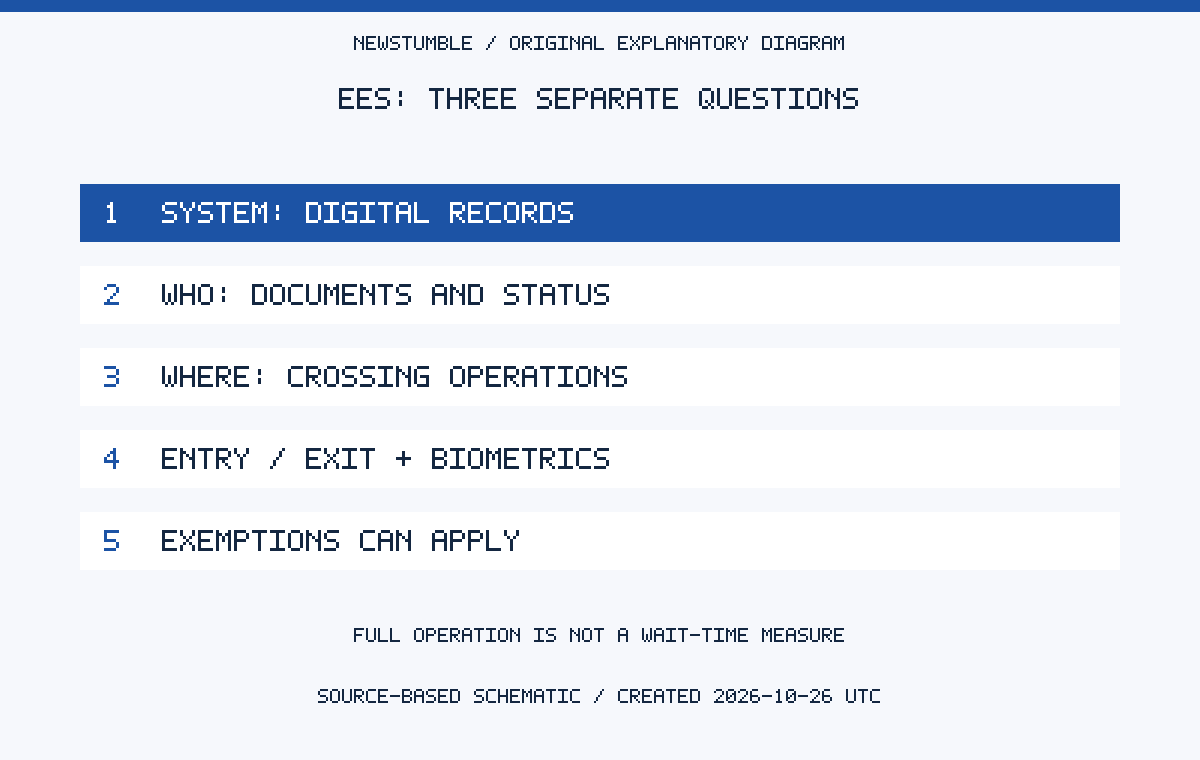
The European Union’s Entry/Exit System reached its April 10, 2026 full-operation milestone after a rollout begun the previous October. The European Commission said electronic records replaced passport stamps for covered short-stay travelers across participating countries. [1]
EES records names, travel-document details, fingerprints, facial images, crossing dates and places, and refusals of entry. The Commission identifies eu-LISA as its developer and manager. Recording a crossing and deciding how long someone may stay remain different functions. [1]
The House of Commons Library’s July briefing explains that covered non-EU visitors still faced the Schengen allowance of 90 days in a 180-day period. Electronic recording did not grant extra days. [2]
The Commission’s July explanation exempted EU nationals and nationals of Iceland, Liechtenstein, Norway and Switzerland. Non-EU holders of long-stay visas or residence permits issued by EES countries were also exempt; documents from Cyprus or Ireland did not carry that exemption. [3]
Family documentation mattered too. The Commission said non-EU family members of EU or qualifying associated-country citizens with residence cards or permits were exempt even when traveling separately. Family members without those documents would be registered. [3]
Implementation nevertheless varied. The Commons Library reported that most travelers at the three UK departure crossings had not been fully brought into EES by April 10 because of software-connection delays. In July, Dover and Eurotunnel were still registering travelers manually without biometrics. [2]
The July Commission notice establishes continued operation after April. The parliamentary account distinguishes a system milestone from conditions at particular crossings. Neither supplies a guaranteed journey time or a verified account of today’s queue. [2] [3]
The source
- European Commission, DG Migration and Home Affairs: Entry/Exit System (EES) ↗
Source published 2026-04-10 · reviewed October 25, 2026 · The page is explicitly dated 10 April 2026 and describes completed full operation. Later July follow-through is separately cited. - House of Commons Library: The EU Entry/Exit system and EU travel authorisation system ↗
Source published 2026-07-17 · reviewed October 25, 2026 · Official parliamentary research briefing carries Published Friday, 17 July, 2026; it also contains later-in-July references. Those later passages are not used to establish events as of July 17. Its dated implementation discussion is attributed, not treated as fresh original field reporting. - European Commission, DG Migration and Home Affairs: The Entry Exit System is fully operational since 10 April 2026. Who is exempt? ↗
Source published 2026-07-27 · reviewed October 25, 2026 · explicit document dateline
About this item: Retrospective report. No first-hand reporting or independent testing is claimed. Corrections policy.