Census growth slowdown put migration estimates and their limits in focus
Retrospective: January's population release showed a smaller international migration balance, with consequences for how communities read funding and statistical data.
- Event / announcement date
- 2026-01-27
- Earliest linked source date
- 2026-01-27
- NewsTumble first published
- 2026-10-26T07:32:01Z
- NewsTumble updated
- 2026-10-26T07:32:01Z
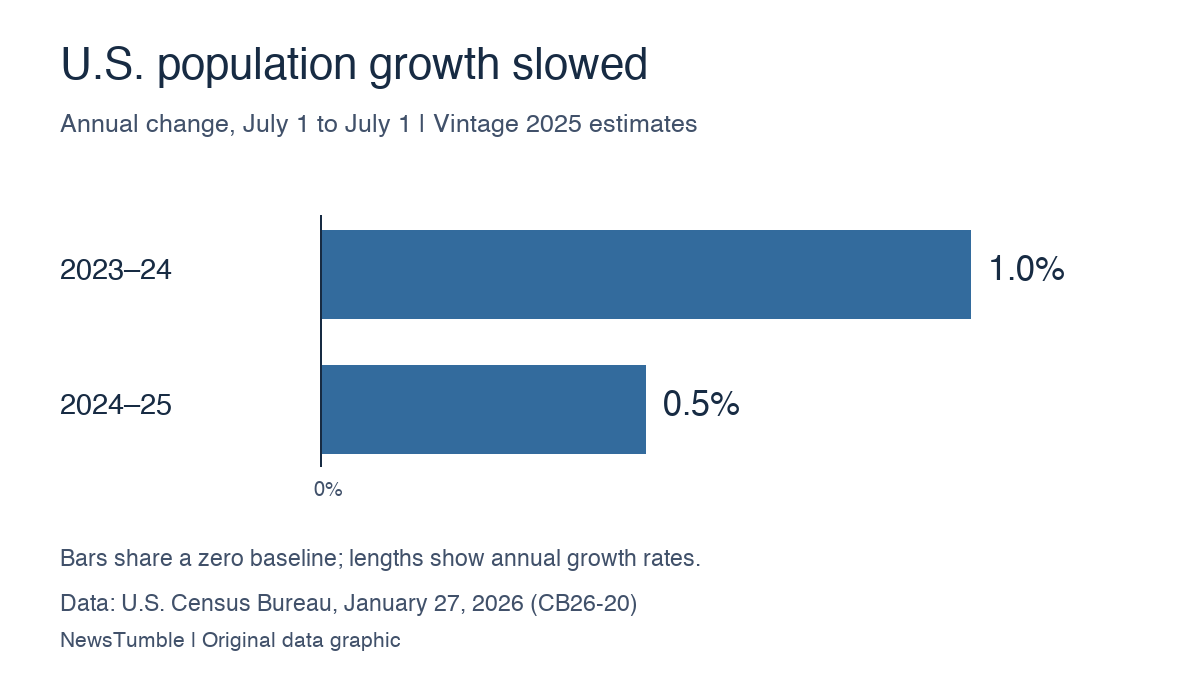
The Census Bureau's January 27, 2026 estimates showed U.S. population growth slowing to 0.5% in the year ending July 1, 2025, down from 1.0% a year earlier. The country added 1.8 million residents, reaching 341.8 million. Census attributed the slowdown mainly to a smaller net gain from international migration. [1]
Births exceeding deaths added about 519,000 people, little changed from the previous year. That contribution was well below the roughly 1.1 million recorded in 2017. Net international migration fell from 2.7 million to 1.3 million, leaving a smaller population increase even with natural change broadly steady. [1]
The migration number needs careful interpretation. It measures arrivals minus departures, rather than arrivals alone, and Census does not provide these immigration estimates by legal status. The reporting year covered July 2024 through June 2025, spanning two different immigration-policy periods. That timing limits what readers can infer about any single administration from the annual figure. [2]
Measuring departures is especially difficult because people who have left cannot answer a U.S. household survey. Census examined surveys, Homeland Security repatriation records and Mexican survey data. Its methods explanation cautioned that a falling foreign-born survey population can also reflect nonresponse, coverage problems or population controls. A survey decline alone therefore cannot establish how many people emigrated. [2]
The national slowdown also concealed different state growth mechanisms. South Carolina led percentage growth at 1.5%, driven by domestic migration. Utah grew mainly through births exceeding deaths. These distinctions matter when interpreting a state's overall growth rate: similar totals can reflect different demographic changes. [1]
These estimates have uses beyond population rankings. Census's program reference says they enter federal funding allocations, help control survey results and provide denominators for vital rates and per-person statistics. The program updates the last decennial census using births, deaths and migration. Population measurement thus feeds both resource decisions and the statistical measures used to understand communities; the reference does not quantify any particular community's funding change. [3]
For comparisons, Census advises using years from the same vintage, or release series. Each new vintage revises the historical estimates back to the last census and replaces older versions. Comparing last year's publication with this year's can therefore mix demographic change with revisions to measurement. [1]
The January methods explanation also projected net international migration of about 321,000 for the year ending June 2026, conditional on continuing trends. Its assumptions included doubling certain 2025 emigration estimates for Mexico and other Latin American countries. That was a projection, not an observed outcome. This retrospective has not independently verified whether it occurred. [2]
The source
- U.S. Census Bureau: U.S. Population Growth Slows Due to Historic Decline in Net International Migration ↗
Source published 2026-01-27 · reviewed October 25, 2026 - U.S. Census Bureau: New Population Estimates Show Historic Decline in Net International Migration ↗
Source published 2026-01-27 · reviewed October 25, 2026 - U.S. Census Bureau: About Population and Housing Unit Estimates ↗
Undated reference · reviewed October 25, 2026 · No publication date is given on this reference. It separately shows a last-revised date of May 26, 2026; that is not treated as its original publication date.
About this item: Retrospective report. No first-hand reporting or independent testing is claimed. Corrections policy.