Birth-hospital enrollment measured an RSV access route
Retrospective: CDC’s 2025 report counted facilities and orders, not infant outcomes.
- Event / announcement date
- 2025-11-20
- Earliest linked source date
- 2023-08-25
- NewsTumble first published
- 2026-10-26T15:32:22Z
- NewsTumble updated
- 2026-10-26T15:32:22Z
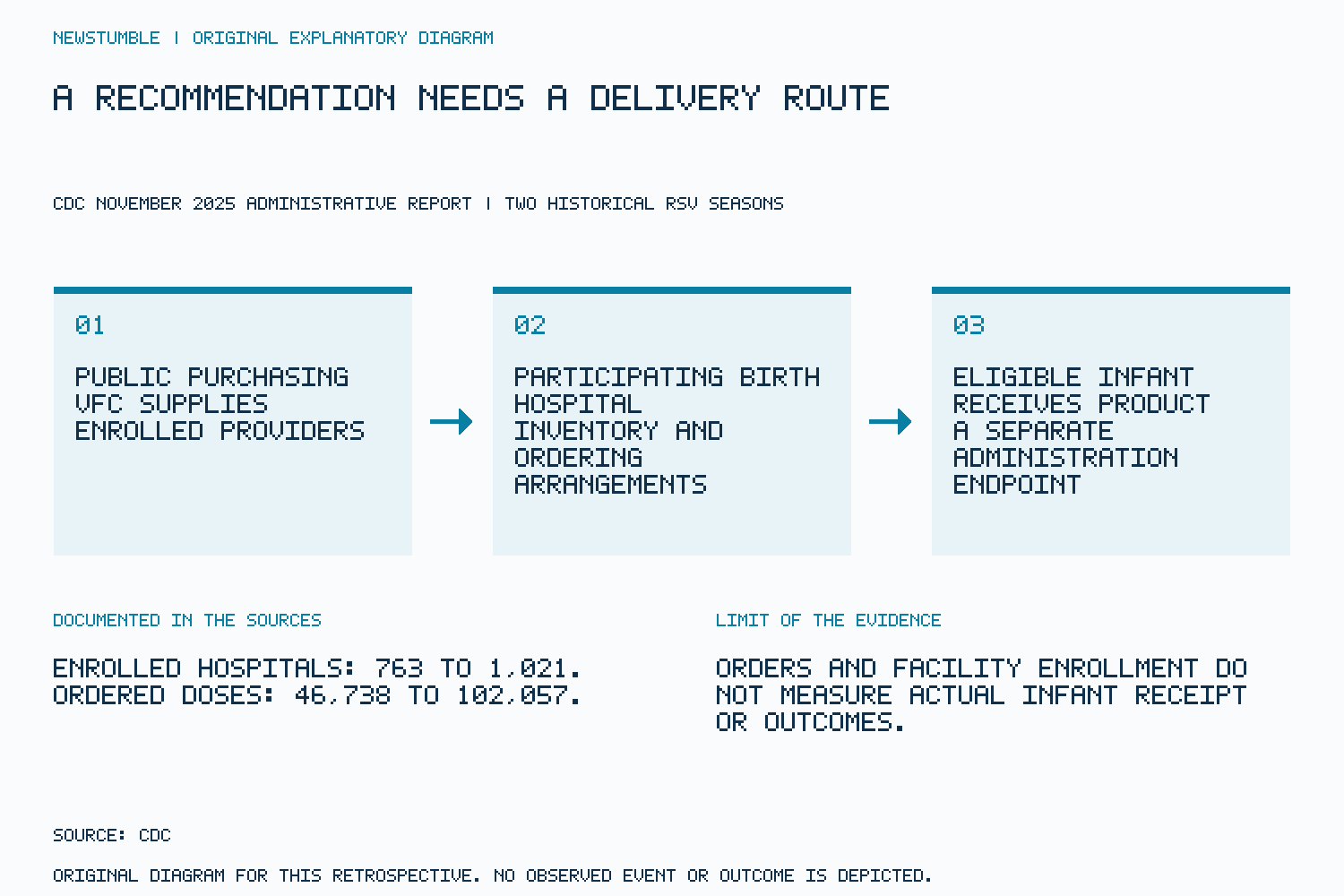
A November 20, 2025 CDC report found that birthing-hospital enrollment in Vaccines for Children rose from 763 to 1,021 across the 2023–24 and 2024–25 RSV seasons: 27.1% to 36.2% of 2,817 facilities. Enrollment measures infrastructure, not infant immunization. [1]
The access problem had a timetable. CDC’s 2023 recommendation placed nirsevimab, a long-acting antibody, within a week of birth for eligible infants born during the RSV season, in hospital or an outpatient setting. Seasons varied geographically. The earlier preventive antibody palivizumab required monthly dosing and was limited to some children with underlying conditions. These are historical recommendations, not a current treatment schedule. [2]
Vaccines for Children offered an existing purchasing mechanism. CDC traces its origins to the 1989–91 measles epidemic, when vaccine cost prevented vaccination even among some children who had seen a provider. Congress created the program in 1993; it opened in October 1994. Public purchasing addressed product cost, while administration still required an enrolled provider. [3]
CDC simplified ordering and inventory policies, including allowing hospitals to stock only immunizations recommended within a week of birth. Nirsevimab orders rose from 46,738 to 102,057 doses. Procurement does not establish administration or avoided hospitalizations. [1]
The comparison matched provider records to the same hospital list at both time points, with jurisdiction review. It did not follow individual infants. [1]
The earlier clinical review assessed trial evidence and certainty about product performance; this facility comparison answered a different question. It did not establish when individual infants received a dose or their health outcomes. [1] [2] [3]
The source
- CDC: Notes from the Field: Expanding Birthing Hospital Enrollment in the Vaccines for Children Program to Increase Infant Immunization Against Respiratory Syncytial Virus — United States, October 2023–March 2025 ↗
Source published 2025-11-20 · reviewed October 25, 2026 · Date displayed on the actual source; separate from the covered event. - CDC: Use of Nirsevimab for the Prevention of Respiratory Syncytial Virus Disease Among Infants and Young Children: Recommendations of the Advisory Committee on Immunization Practices — United States, 2023 ↗
Source published 2023-08-25 · reviewed October 25, 2026 · Date displayed on the actual source; separate from the covered event. - CDC: About the Vaccines for Children (VFC) Program ↗
Source published 2024-07-16 · reviewed October 25, 2026 · Page explicitly distinguishes Published: July 16, 2024 from Updated: August 27, 2026. Cited snapshot includes the 2026 update; program history is context.
About this item: Retrospective report. No first-hand reporting or independent testing is claimed. Corrections policy.