Ultrasound-gel genome links did not all signify infection
Retrospective: A 2025 investigation separated genetic relatedness from clinical interpretation.
- Event / announcement date
- 2025-12-11
- Earliest linked source date
- 2022-12-02
- NewsTumble first published
- 2026-10-26T15:32:22Z
- NewsTumble updated
- 2026-10-26T15:32:22Z
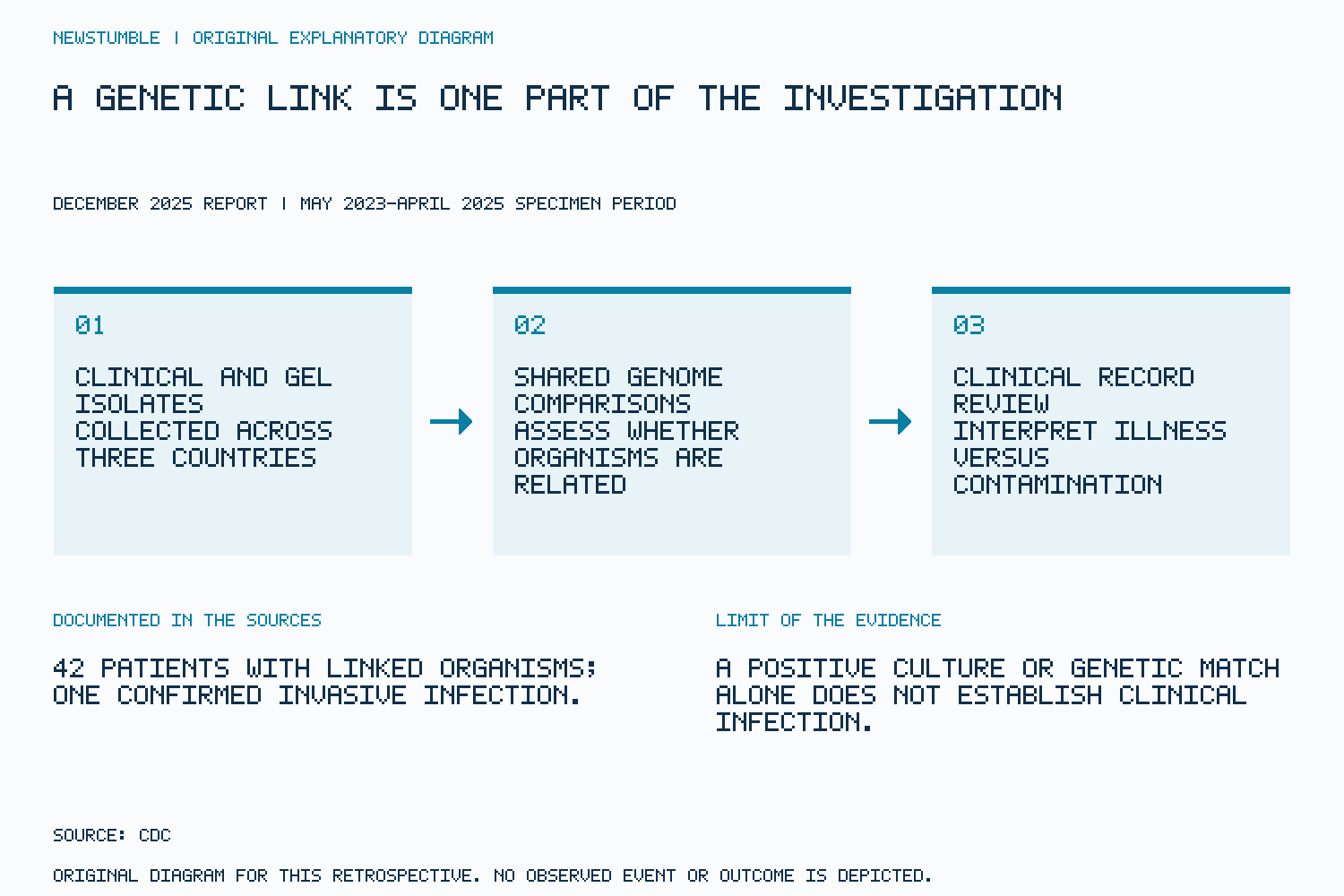
A December 11, 2025 investigation linked Paraburkholderia in clinical specimens and nonsterile ultrasound gel across the United States, Canada and Israel. Forty-two patients had genetically related organisms in specimens collected during May 2023–April 2025; medical-record review confirmed invasive infection in one. [1]
Of thirty-seven patients with clinical information, twenty-eight had antibiotic treatment started, changed or extended; providers ultimately judged twenty-five results contaminants. That does not establish that every antibiotic course was unnecessary. [1]
A separate CDC report published in December 2022 described 119 Burkholderia stabilis infections associated with contaminated nonsterile gel during 2021. Contamination in unopened containers supported investigation of the product itself. This was a different organism and outbreak: its total cannot be added to the later cluster or used to infer the later organism’s severity. [2]
The older report explained how gel remaining on skin could carry bacteria into a sterile site during needle procedures. It called for sterile, single-use gel for relevant procedures and equipment cleaning and disinfection. Those were practice recommendations, not evidence that every facility followed them. [2]
The later authors could not confirm gel use for every patient from retrospective charts. Detection was not reportable, so they cautioned that incidence was likely underestimated. A genetic match did not settle whether every culture represented infection. [1]
Minnesota’s accompanying page lists sequencing and bioinformatics methods, raw-read and assembly statistics, a comparison matrix and genomic figures. These are ways to inspect the laboratory evidence behind the shared-genome investigation. A reader can distinguish the evidence of related organisms from clinical interpretation, but the availability of files neither reproduces the analysis nor resolves the uncertainty in individual records. [3]
The source
- CDC: Detection of Paraburkholderia in Clinical Specimens Associated with Use of Nonsterile Ultrasound Gel for Percutaneous Procedures — United States, Canada, and Israel, May 2023–April 2025 ↗
Source published 2025-12-11 · reviewed October 25, 2026 · Date displayed on the actual source; separate from the covered event. - CDC: Outbreak of Burkholderia stabilis Infections Associated with Contaminated Nonsterile, Multiuse Ultrasound Gel — 10 States, May–September 2021 ↗
Source published 2022-12-02 · reviewed October 25, 2026 · Date displayed on the actual source; separate from the covered event. - Minnesota Department of Health: List of Supplementary Materials for MMWR: Detection of Paraburkholderia Associated with Contaminated Nonsterile Ultrasound Gel ↗
Undated reference · reviewed October 25, 2026 · No publication date is given on this context reference. The page explicitly displays Last Updated: 12/11/2025; that update date is retained separately and is not treated as first publication.
About this item: Retrospective report. No first-hand reporting or independent testing is claimed. Corrections policy.