Moving antiprotons toward quieter measurements
September’s paper documented transport within CERN. Greater precision remained an experimental goal.
- Event / announcement date
- 2026-09-16
- Earliest linked source date
- 2022-01-05
- NewsTumble first published
- 2026-10-26T23:36:07Z
- NewsTumble updated
- 2026-10-26T23:36:07Z
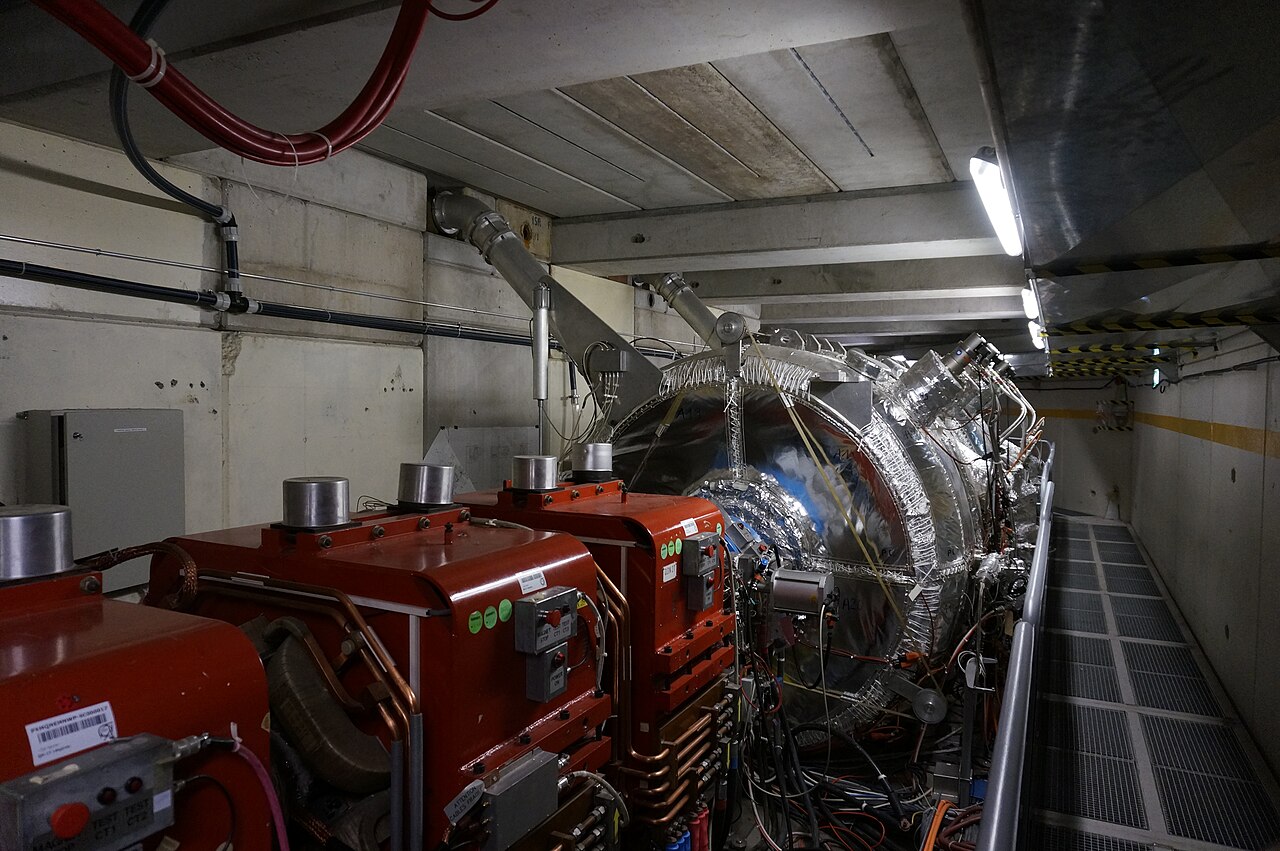
Historical report — A paper published in Nature on September 16, 2026 described transporting 92 antiprotons over 7.5 kilometres within CERN. The team reported no particle loss or measurable degradation of the trap’s vacuum during that journey. [1]
The scientific purpose predates the truck journey. A January 2022 study compared proton and antiproton charge-to-mass ratios with uncertainty of 16 parts per trillion. Its result was consistent with the tested matter–antimatter symmetry. Increasing measurement precision can test that agreement more closely; it is not evidence that a difference has already been found. [2]
A May 2025 paper had demonstrated transport with protons, using the mobile trap across CERN’s site and operating autonomously without external power for four hours. That was a practical precursor involving ordinary matter. It did not itself establish whether the vacuum needed to preserve antiprotons would survive a road journey. [3]
The BASE collaboration’s March 2026 account explained the pressure to move: accelerator operations introduce fluctuations that limit precision at the production facility. It described construction of an offline laboratory in Düsseldorf. Moving particles and establishing a quieter measurement environment were linked steps, rather than a declaration that the destination experiments were complete. [4]
The September paper established transport feasibility in the tested conditions. Its projected precision gains remained a goal for quieter experiments, not a measurement of asymmetry between matter and antimatter. [1]
The source
- Nature: Road transport of trapped antiprotons ↗
Source published 2026-09-16 · reviewed October 26, 2026 - Nature: A 16-parts-per-trillion measurement of the antiproton-to-proton charge–mass ratio ↗
Source published 2022-01-05 · reviewed October 26, 2026 - Leonhardt et al. / Nature: Proton transport from the antimatter factory of CERN ↗
Source published 2025-05-14 · reviewed October 26, 2026 - BASE collaboration: First Transport of Antiprotons in Our Open Penning Trap System BASE-STEP ↗
Source published 2026-03-24 · reviewed October 26, 2026
About this item: Retrospective report. No first-hand reporting or independent testing is claimed. Corrections policy.