Mongolia’s fossil handover showed how customs recovery can restore a research collection
A December 2025 ceremony followed years of investigation; returning specimens and rebuilding their scientific use remain separate tasks.
- Event / announcement date
- 2025-12-08
- Earliest linked source date
- 2025-12-08
- NewsTumble first published
- 2026-10-26T13:02:50Z
- NewsTumble updated
- 2026-10-26T13:02:50Z
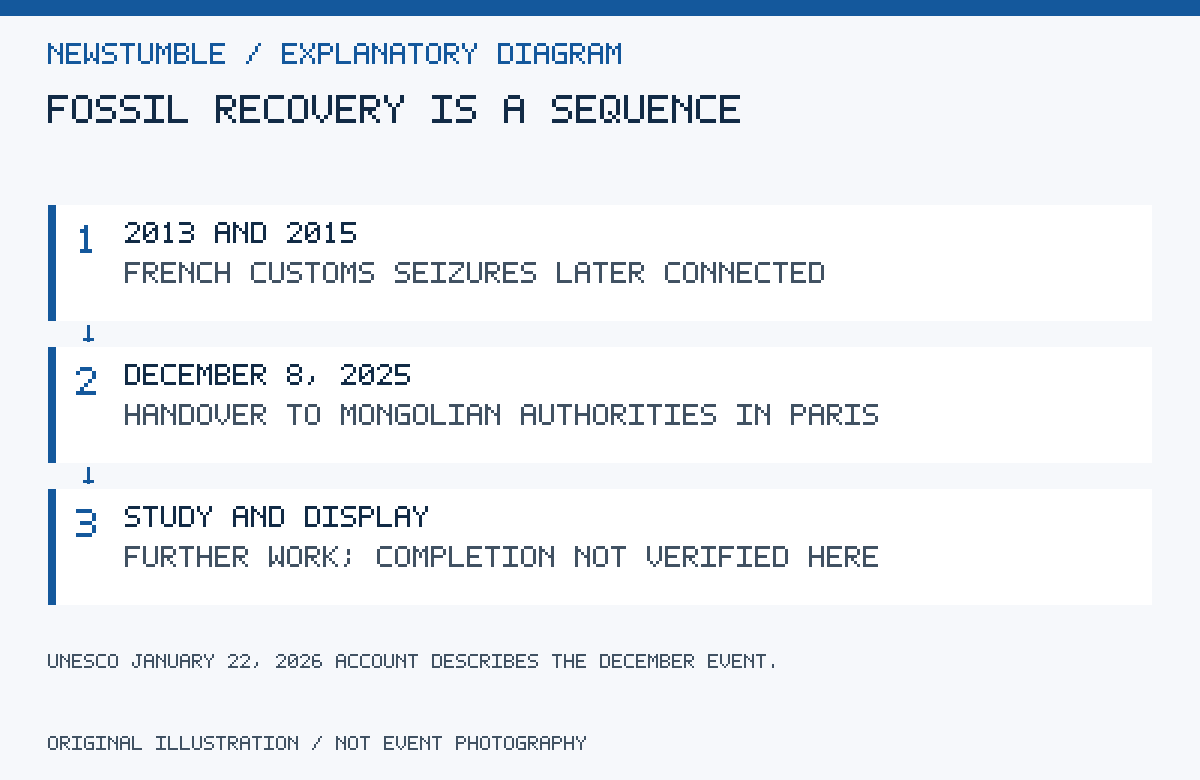
France handed a Tarbosaurus bataar skeleton and other dinosaur fossils to Mongolian authorities in Paris on December 8, 2025. A later UNESCO account dates the ceremony explicitly, while the French ministry issued its release that day. The event concerned returning recovered heritage to its country of origin, with scientific study and public presentation still requiring further work. [1] [2]
The French account traces the investigation back to an August 2013 discovery at Le Havre: customs found 998 undeclared fossils inside quartz barrels after information from Brazil. A separate February 2015 seizure near Lyon uncovered nine crates containing the Tarbosaurus skeleton. Investigators then connected the cases. The Brazilian fossils were returned in 2022, a separate event from the Mongolian handover. [2]
French Customs’ accompanying dossier explains the research problem posed by dispersal. Individual sales at auctions, online markets and fossil fairs can separate specimens and diminish the anatomical information scientists can assemble. Keeping associated material together can therefore matter beyond recovery of an impressive skeleton. [3]
Palaeontologist Ronan Allain of the Muséum national d’histoire naturelle (MNHN), in the Customs dossier, places Tarbosaurus among carnivorous theropods, as an Asian relative of Tyrannosaurus rex. Specimens are held in museums in Mongolia, China and Poland. His account says Mongolian law treats dinosaur fossils as government property and criminalizes export, explaining the ownership concern. [3]
UNESCO situates the restitution within the principles of its 1970 cultural-property convention and describes investigations and judicial proceedings before return was ordered. In that account, bilateral cooperation was the route from a customs seizure to a handover. Recognition under an international convention should not be confused with an automatic process that instantly moves every disputed specimen across a border. [1]
Mongolian authorities, in the dossier’s interview, presented the fossils as future research material and exhibits after study and analysis. Receipt, preparation and display are separate activities. Their predictions that the objects would attract visitors were expectations, rather than measured attendance or educational results. [3]
The January 22, 2026 UNESCO article is a later account of the December ceremony, not a second restitution announcement. The reviewed records establish that handover and its investigative background; they do not establish a completed new display or a published research result from these particular returned specimens. Those outcomes need their own evidence before being reported as accomplished. [1]
The source
- UNESCO: France returns a Tarbosaurus bataar skeleton and dinosaur fossils to ↗
Source published 2026-01-22 · reviewed October 25, 2026 · explicit-source-date - French Ministry of Economy and Finance: Amélie de Montchalin remet aux autorités de Mongolie un squelette de Tarbosaurus Bataar ainsi que de nombreuses parties de dinosaures saisis par la douane en 2015 – Presse – Ministère des Finances ↗
Source published 2025-12-08 · reviewed October 25, 2026 · explicit-source-date - French Customs: Remise aux autorités de Mongolie d’un squelette de Tarbosaurus bataar ↗
Undated reference · reviewed October 25, 2026 · No publication date is given. No explicit publication date is given in the PDF read; the ministry release links this dossier on December 8, 2025. The path date is not used as a publication date.
About this item: Retrospective report. No first-hand reporting or independent testing is claimed. Corrections policy.