Montreal monitoring plans required testing and financing
Retrospective: The 2025 record distinguished candidate sites from operating stations.
- Event / announcement date
- 2025-11-12
- Earliest linked source date
- 2025-11-12
- NewsTumble first published
- 2026-10-26T15:32:22Z
- NewsTumble updated
- 2026-10-26T15:32:22Z
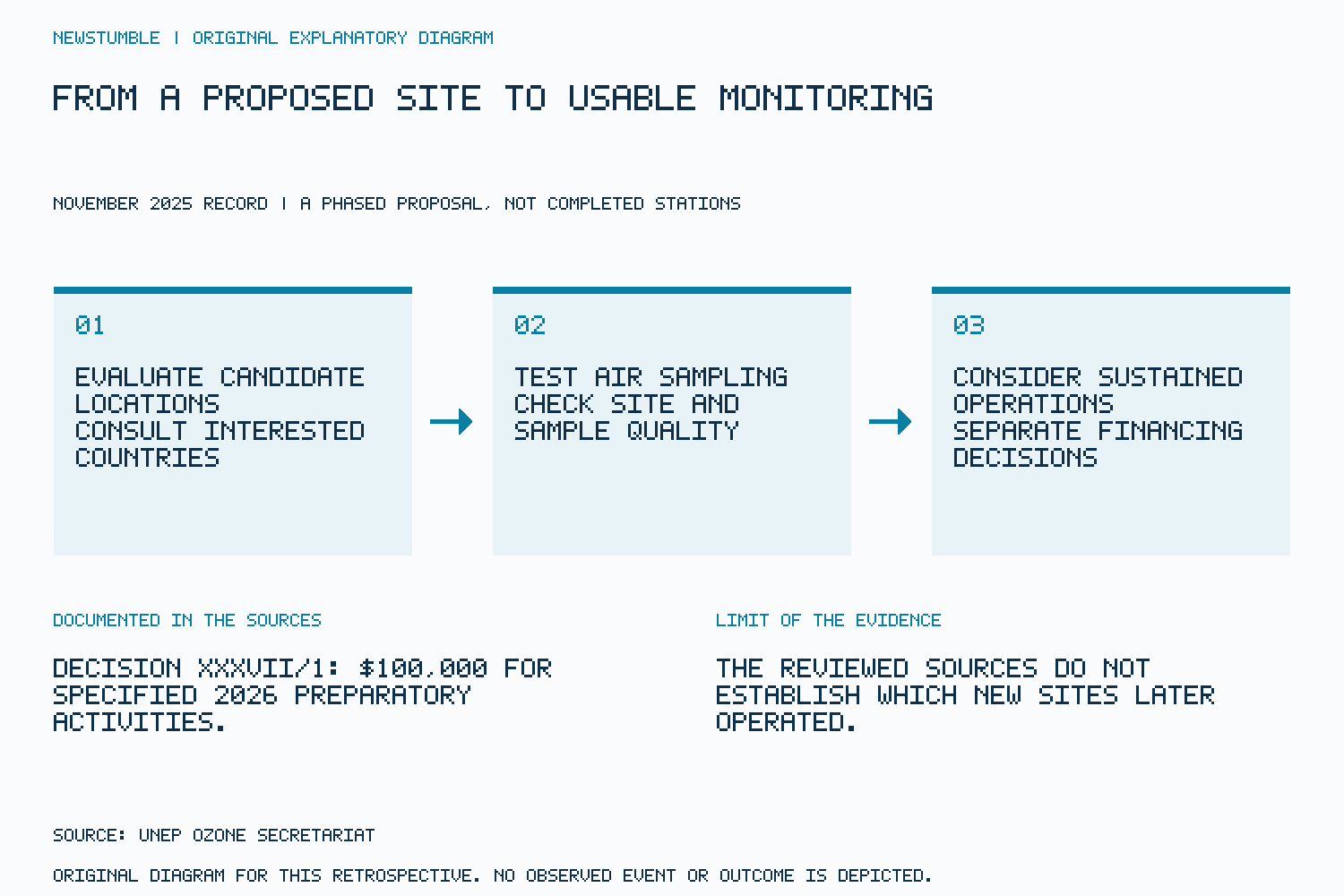
The Montreal Protocol’s November 12, 2025 meeting report described ten potential monitoring regions and locations, with five prioritized. Candidate locations were a planning step, not ten operating stations. [1]
Decision XXXVII/1 requested further site evaluation and preparations with interested countries’ voluntary participation. It provided an exceptional $100,000 budget line for specified 2026 activities from the Protocol trust fund’s cash balance. It did not finance an entire permanent network. [2]
This followed Decision XXXVI/1 work on suitability, costs and long-term financing. Priority regions included South and Southeast Asia, southern Africa, the Middle East and South America; existing infrastructure and expertise influenced selection. [1]
Monitoring methods create different staffing requirements. In-situ instruments and expertise remain on site; flask samples go to established laboratories elsewhere. The report emphasized testing suitability and data quality: a leaking flask skewed some Bhola Island pilot results. [1]
The decision also required progress reports to the next Open-ended Working Group and Meeting of the Parties. It asked the Multilateral Fund’s Executive Committee to consider costs and the phased approach when developing guidelines and a possible pilot-project funding window. That was another funding decision, not an award to each candidate. [2]
The Secretariat’s November 13 summary connected this work to gaps between reported and measured HFC-23 emissions. Better observations could help examine that discrepancy; it did not identify a new source or prove misconduct. The reviewed record establishes the 2025 decision, not which sites subsequently operated or how continuing operations were financed. [3]
The source
- UNEP Ozone Secretariat: UNEP/OzL.Pro.37/9: Report of the Thirty-Seventh Meeting of the Parties ↗
Source published 2025-11-12 · reviewed October 25, 2026 - UNEP Ozone Secretariat: Decision XXXVII/1: Enhancing regional atmospheric monitoring of substances controlled by the Montreal Protocol ↗
Undated reference · reviewed October 25, 2026 · No publication date is given on this context reference. Historical dates and dates of listed events are not its publication date. - UNEP Ozone Secretariat: Thirty-Seventh Meeting of the Parties meeting summary ↗
Source published 2025-11-13 · reviewed October 25, 2026 · Date displayed on the actual source; separate from the covered event.
About this item: Retrospective report. No first-hand reporting or independent testing is claimed. Corrections policy.